

Imagine the internet as an enormous, endless library. In this library, search engines like Google act as the hard-working librarians. Their main goal is to offer you the most helpful, relevant, and different types of information available.
Now, imagine walking into that library and finding ten copies of the exact same book on the shelf. It would be confusing, right?
That is exactly why is having duplicate content an issue for SEO. SEO (Search Engine Optimization) is what helps search engines figure out which content is the best to show people. At the heart of good SEO is uniqueness.
If your website has the exact same words on multiple pages, the search engines get confused. It makes it very hard for them to decide which page is the best one to show a user. This can cause your website’s rankings to drop, meaning fewer people will visit your site.
Are you struggling with confusing website errors? We are Seo Expert Service, and we can help you clean up your site today email us : contact@seoexpertservice.com
Table of Contents
What Exactly is Duplicate Content?
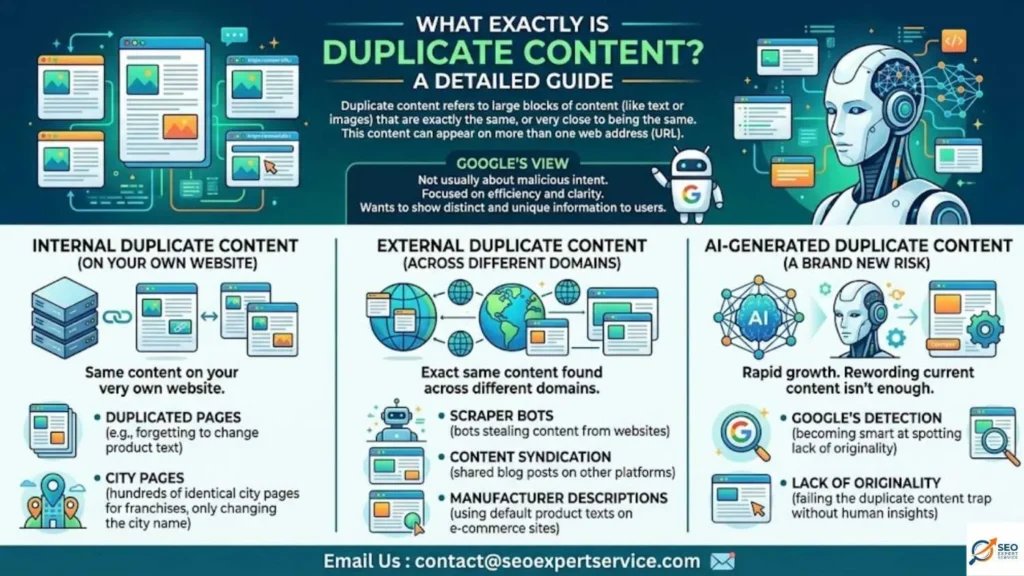
Before we dive deeper into why is having duplicate content an issue for SEO, we need to know what it is.
Duplicate content refers to large blocks of content (like text or images) that are exactly the same, or very close to being the same. This content can appear on more than one web address (URL).
From Google’s point of view, having duplicate content isn’t usually about someone trying to be bad or break the rules. It is simply about efficiency and clarity. Google wants to show distinct and unique information to its users.
There are a few main types of duplicate content you should know about.
Internal Duplicate Content
This happens when you have the same content on your very own website.
For example, you might “duplicate” a page to quickly make a new product or service page, but forget to change the text. This is very common on franchise websites that use the exact same text for hundreds of city pages, only changing the city name.
External Duplicate Content
This happens when the exact same content is found across different domains (different websites).
Sometimes, this is because a scraper (a bot that steals content) copied your website. Other times, it is because of content syndication, which means you shared your blog post on another platform. It also happens when online stores use the exact same default product descriptions provided by the manufacturer.
AI-Generated Duplicate Content
Today, AI-generated content is growing fast. This is a brand new risk for duplicate content.
Many people try to use AI to just reword current content, but that is no longer good enough. Google is getting very smart at detecting content that lacks true originality. If you just rely on AI without adding your own unique human insights, you will fall right into a duplicate content trap.
Why Is Having Duplicate Content an Issue for SEO? (The Main Reasons)
Many people think duplicate content just lowers your rank, but the reality is much more complicated. So, exactly why is having duplicate content an issue for SEO?
It triggers a whole “domino effect” of problems that can hurt your website’s online presence. Let’s break down the biggest SEO risks.
1. The Struggle for Rank Supremacy (Search Engine Confusion)
Search engines use complex math (algorithms) to rank pages. When they find multiple URLs with the same content, it introduces a big problem: which version should be the winner?.
Because Google is confused, it might pick the wrong page to show in the search results. Or, it might bounce back and forth between the different versions, making your website’s performance very unstable.
2. The Backlink Dilemma (Splitting Your Power)
Backlinks (when other sites link to you) are like the backbone of SEO. They act as a “vote of confidence” for your website.
If you have three identical pages, people might link to all three differently. This splits up your positive ranking signals. Instead of having one super-strong page, you have three weak pages. Your website will struggle to build the authority it needs to rank high.
3. The Crawl Budget Conundrum
Google sends little robots (crawlers) to read your website, but they have a limited “crawl budget”. This means they only have a certain amount of time to look at your pages.
If you have duplicate content, these robots waste their time reading the same thing over and over. Because of this, they might run out of time and completely miss your new, valuable pages. This can stop your website from growing.
4. Keyword Cannibalization
When you have identical or similar pages, they end up fighting against each other for the exact same keywords. This is called keyword cannibalization.
Instead of dominating the search results, your own pages defeat each other.
Will Duplicate Content Trigger a Google Penalty?
This is one of the most searched questions on the internet. You might have heard scary stories about a “Google duplicate content penalty”.
Here is the truth: For the most part, a direct penalty is a myth. The direct answer is usually no; duplicate content does not automatically trigger a penalty.
Instead of punishing you, Google just tries to group the similar pages together, picks the best one, and filters the rest out of the search results.
However, there are rare cases where it becomes a manual issue.. If a website tries to trick the search engine by creating “doorway pages,” “thin duplication,” or manipulative spam to dominate the search results, Google will step in. But most regular SEO duplicate content issues are just accidents and won’t get you penalized.
Are you worried your site has been penalized? Let our experts take a look email us : contact@seoexpertservice.com
The Impact Beyond SEO (Why Your Business Should Care)
Why is having duplicate content an issue for SEO? It goes way beyond just search engines. It can actually hurt your real-world business.
User Frustration
Imagine you are searching for information and you keep clicking on different links, only to find the exact same words over and over. It’s very confusing and frustrating.
When users have a poor experience, they bounce right off your website.
Loss of Brand Authority & Trust
Trust suffers when users see repetitive pages. If a customer sees your text, and then sees the exact same text on a competitor’s site, who do they trust?.
They might assume you just copied the content and that you are not a real leader in your industry. Your brand just blends in instead of standing out.
Reduced Conversion Rates
Duplicate content dilutes your conversions. If Google gets confused and ranks the wrong version of your page, users might land on a page that doesn’t have a good “Buy Now” button or optimized sales message.
This leads to reduced engagement, and users will leave your site much faster without buying.
Legal & Copyright Risks
Plagiarism isn’t the only issue, but it is a big one. If someone copies your work, or if you accidentally use someone else’s duplicate content, you could face legal trouble.
Other websites could ask to have your content taken down under the DMCA (Digital Millennium Copyright Act).
Common Causes of Duplicate Content (How It Happens)
Most of the time, duplicate content is totally unintentional. It happens quietly in the background without you even knowing. Here are the most common causes:
1. URL Variations and Tracking Parameters
Sometimes, marketers add special codes to a link to track where a click came from (like from Facebook or an email). For example: example.com/page and example.com/page?utm_source=fb. Even though they show the exact same page, search engines see these as two totally distinct pages.
2. Incorrect Server Configuration (HTTP vs. HTTPS)
Your website should have a secure connection (HTTPS). If your website can be loaded with both “HTTP” and “HTTPS,” search engines will treat them as two separate, duplicate websites.
This duplicates every single sub-page on your entire site!. The same thing happens if your site loads both with “www” and without “www”.
3. E-commerce Product Pages
Online stores are very vulnerable to this. If an online store has a shirt in 12 different colors, their system might create 12 different URLs. If the product descriptions are all identical, that creates massive duplication.
Also, stores often use “faceted navigation” (filters for size, color, price) that generate lots of similar pages with minor URL changes.
4. WordPress Tags, Categories, and Archives
If you use WordPress, you might be creating duplicates without knowing it. WordPress automatically makes an “archive page” for every category and tag you create.
If your website theme shows the entire blog post on the category page instead of just a short summary, it creates duplicate content. Also, if you use too many tags, you create thin, low-value pages that just repeat each other.
5. Multi-Language Translation Issues
If you use plugins to translate your website into Spanish or French, you might clone the English page first. If you forget to actually translate the words, you end up with identical English content on a page that Google thinks should be Spanish.
6. Duplicated Landing Pages for Ads
Sometimes, businesses want to run a Google Ad and a Facebook Ad. They quickly duplicate their main “Services” page to make tracking easy. If 90% of the text is identical across all those landing pages, search engines will get confused about which one should rank organically.
How to Find Duplicate Content on Your Website
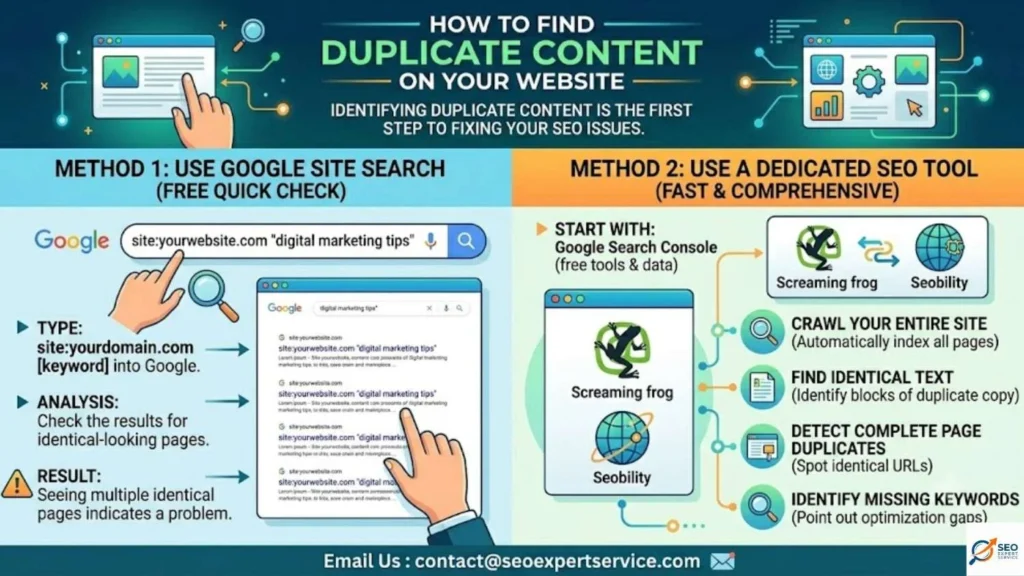
You cannot fix a problem if you don’t know it is there. Luckily, finding duplicate content is usually quite easy once you know what to look for.
Use Google Site Search: You can do a quick check right on Google for free. Just type site:yourdomain.com followed by a keyword into the Google search bar. This will show you all the pages on your site that use that keyword. If you see multiple pages that look identical, you have a problem.
Use a Dedicated SEO Tool: Using software is the fastest way to find issues. Tools like Google Search Console are the best place to start. You can also use paid tools like Screaming Frog or Seobility to crawl your entire site automatically. These tools will point out identical text, missing keywords, and complete page duplicates.
If you need a professional to audit your website, Seo Expert Service has the tools and the talent email us : contact@seoexpertservice.com
Expert Advice: How to Fix and Prevent Duplicate Content
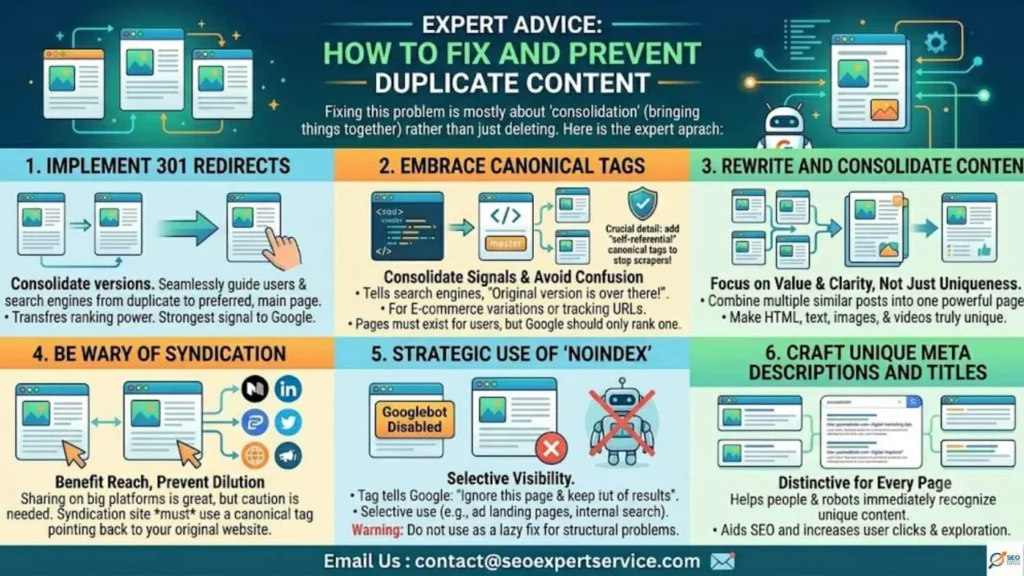
Now that we fully understand why is having duplicate content an issue for SEO, how do we steer away from this dangerous territory?.
Fixing this problem is mostly about “consolidation” (bringing things together) rather than just deleting everything. Here is the expert technical approach:
1. Implement 301 Redirects
When you have multiple versions of a page, and you only need one, you should use a 301 Redirect.
This is the strongest signal you can send to Google. A 301 redirect seamlessly guides both users and search engines away from the duplicate page and straight to your preferred, main page. It ensures all the ranking power gets transferred to the right place.
2. Embrace Canonical Tags
A canonical tag is a tiny piece of code you add to a webpage. It tells search engines, “Hey, this page exists, but the original, primary version is over there!”.
This is the perfect fix for E-commerce product variations or tracking URLs, where the pages must exist for users, but you want Google to only rank one of them. By using a canonical tag, you consolidate your ranking signals and avoid confusing the search engine.
Always add “self-referential” canonical tags too. This stops content scrapers from stealing your work and taking credit for it!.
3. Rewrite and Consolidate Content
If you have three blog posts that are very similar, you don’t always need to keep them separate.
Sometimes the best answer is to rewrite them. Combine all the best information into one single, powerful, authoritative page. SEO isn’t just about making things look unique; it is about providing real value and clarity to the reader. Make the HTML text, images, and videos truly unique.
4. Be Wary of Syndication
Sharing your content on big platforms like Medium or LinkedIn is great, but tread carefully.
If you do this, you must ensure the other website includes a canonical tag pointing back to your original website. This way, you get the benefit of a wider audience without diluting your own website’s authority.
5. Strategic Use of “Noindex”
“Noindex” is a tag that tells Google to completely ignore a page and keep it out of the search results.
You should use this selectively. It is great for landing pages you only use for Facebook ads, or internal search result pages. However, do not use it as a lazy, default fix, because it can hide deeper structural problems on your website.
6. Craft Unique Meta Descriptions and Titles
Every page on your website is unique, so people (and robots) should recognize this immediately. Create distinctive meta titles and descriptions for every single page. This not only helps your SEO but also makes users want to click and explore your website more.
Ready to Conquer Duplicate Content and Rise in Search?
Duplicate content can seriously hold back your website’s true potential. It squanders your crawl budget, ruins your link equity, and provides a frustrating experience for your potential customers.
But fear not!. Preventing duplicate content just requires some ongoing technical governance and clear rules. By creating fresh, engaging, and technically sound content, you will satisfy both search engines and your audience.
At Seo Expert Service, we have over 15 years of experience crushing complex SEO issues like this. A technical site audit from our team is the best way to identify and fix these hidden problems.
Are you ready to banish duplicate content and climb the search results ladder?. Get in touch with us to get the most out of your digital assets.
Contact Seo Expert Service Today: contact@seoexpertservice.com
Also Read : How Often Does SEO Need to Be Done
People Also Ask (FAQs)
What is duplicate content?
Duplicate content refers to blocks of content that appear on more than one URL and are identical or substantially similar.
Does duplicate content hurt SEO?
Yes, it can hurt SEO by confusing search engines, diluting your ranking signals, and wasting the search engine’s crawl budget.
Can I get a duplicate content penalty?
In most cases, no. A true penalty from Google only happens if you are trying to be deceptive or manipulative. Usually, Google just ignores the duplicates.
How does Google handle duplicate content?
Google looks at all the similar pages, chooses one “canonical” (primary) version to index and rank, and filters out the rest.
How much duplicate content is acceptable?
There is no exact number or fixed threshold. It depends entirely on your intent, your site structure, and how it impacts the user.