
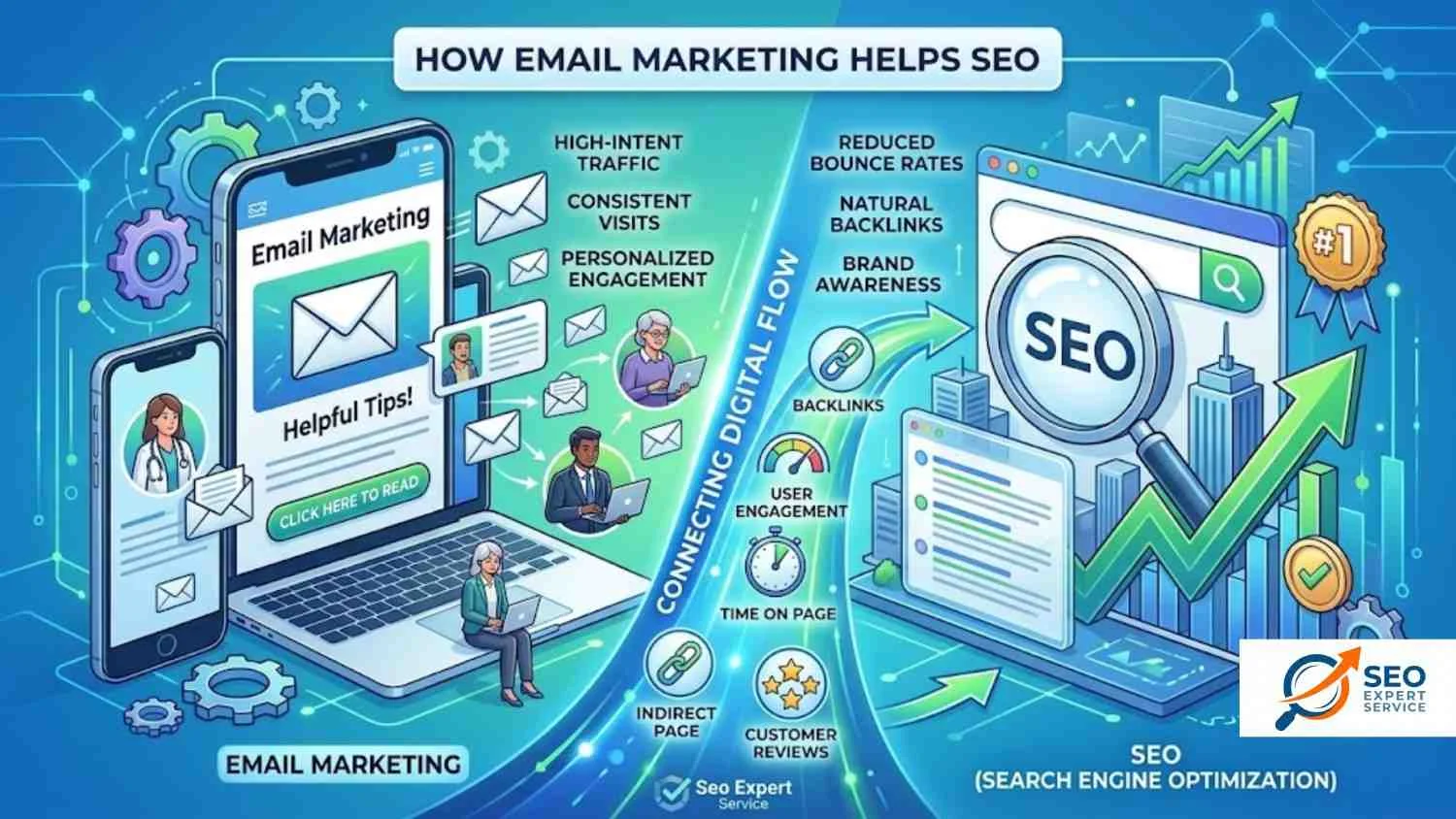
Have you ever wondered how email marketing can help SEO? Think of your website like a brand-new toy store at the end of a quiet street. Search engine optimization (SEO) puts up big, shiny road signs so people can find your door when searching on Google.
Email marketing is like inviting your best friends directly inside with a personalized invitation card. When your friends visit, stay awhile, and tell everyone at school how fun your store is, Google notices the crowd.
At Seo Expert Service, we help businesses combine these two engines to build massive, lasting digital growth. Let’s explore how email and SEO work together like best friends to help your website rank #1.
Table of Contents
What is Email Marketing and SEO?
To understand how these two work together, let’s look at each tool on its own.
What is Email Marketing?
Email marketing is the art of sending helpful, friendly messages straight to an inbox. These messages go to people who asked to hear from you. Businesses send newsletters, product updates, helpful health guides, and special discounts. Because the reader already opted in, email marketing builds direct trust and strong friendships.
What is SEO?
SEO stands for Search Engine Optimization. It means setting up your website so search engines like Google can find it, understand it, and show it on page one. When someone types a question into Google, strong SEO makes sure your helpful answer pops up right at the top.
B2B vs. B2C: What Is the Difference?
- B2B (Business-to-Business): Companies sell to other businesses. Decisions take time, involve teams of leaders, and require deep technical research, high trust, and clear proofs.
- B2C (Business-to-Consumer): Companies sell straight to regular shoppers. Decisions are usually quicker, simpler, and driven by personal wants or daily needs.
Both types of businesses need both email marketing and SEO to thrive in today’s search landscape.
The Big Question: Does Email Marketing Directly Improve Google Rankings?
The short and honest answer is: No, not directly.
Google’s web crawler cannot peek into private inboxes to see your newsletters. Sending one thousand emails will not immediately change your score on Google’s algorithm.
However, email marketing helps SEO indirectly in massive ways.
When people open your emails and click your links, they arrive at your website ready to read. They stay longer, read more pages, share your articles on social media, and link to your guides. Google measures all of these positive user signals.
In modern search algorithms, these genuine human engagement signals make a giant difference in who earns the top spot.
How SEO and Email Marketing Work Together
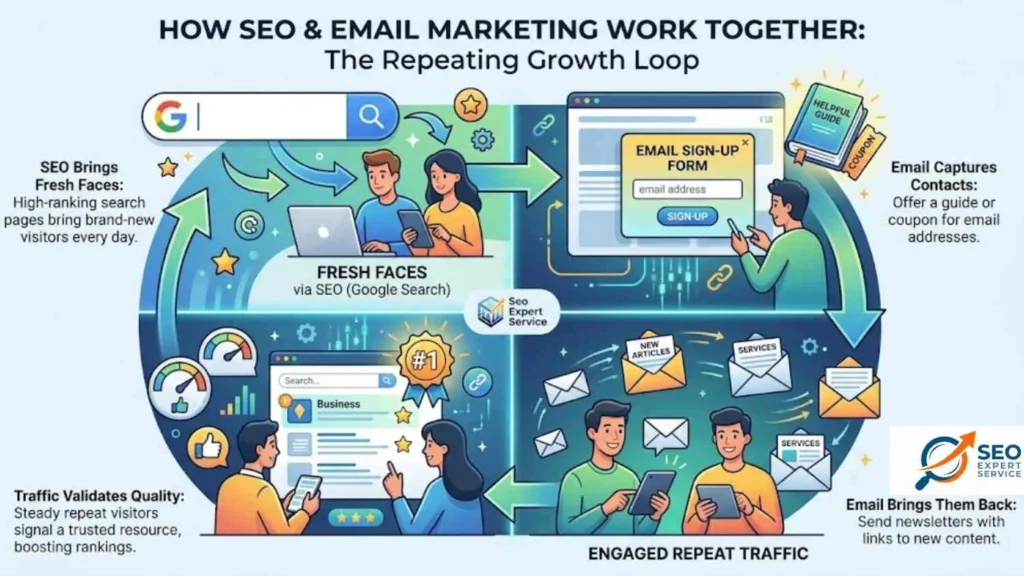
SEO and email marketing form a repeating loop:
[ Google Search ]
│
▼
[ Organic Visitors ] ───► [ Email Sign-up Form ]
│
▼
[ Higher SERP Rank ] ◄─── [ Engaged Repeat Traffic ]
- SEO Brings in Fresh Faces: High-ranking search pages bring brand-new visitors to your website every day.
- Email Captures the Contact: You offer a helpful guide or coupon in exchange for their email address.
- Email Brings Them Back: You send them newsletters that link directly back to your newest articles and services.
- Traffic Validates Quality: The steady flow of repeat visitors proves to search engines that your site is a trusted resource, boosting your rankings higher.
10 Powerful Ways Email Marketing Supports Your SEO Strategy
Here are the 10 proven ways email marketing lifts your SEO performance:
1. Drives High-Intent, Consistent Website Traffic
Search engines love sites that get consistent visits. If your traffic drops to zero whenever you stop running paid ads, search engines might doubt your long-term authority.
Email newsletters deliver a steady, reliable stream of visitors to your site every week. Better yet, these visitors have “high intent”—they genuinely want to read what you wrote.
2. Amplifies User Engagement Metrics
When cold visitors arrive from a generic search, they might leave after three seconds if the page is not an exact fit. But email subscribers already know you.
When they click through, they:
- Spend several minutes reading.
- Click internal links to check out your clinic or service pages.
- Watch your videos and leave thoughtful comments.
This high engagement tells Google your pages provide real value.
3. Reduces Site-Wide Bounce Rates
Bounce rate measures how many people land on a webpage and leave right away without touching anything. Because email subscribers are familiar with your brand, they rarely bounce right away. They click deeper into your website, which drives down your bounce rates and signals trust to search engines.
4. Sparks Natural Backlink Building and Referral Traffic
Backlinks are links from other websites pointing to your website. Google treats them like votes of confidence.
When you send a high-quality guide to your email list, your subscribers include:
- Other bloggers
- Industry experts and researchers
- Journalists looking for facts
When they read your content, they often link to it in their own blogs, news stories, and resource hubs. That earns you natural, high-authority backlinks without messy outreach.
5. Boosts Brand Awareness and Branded Search Demand
When you pop up in your subscriber’s inbox every week with helpful tips, your name stays fresh in their mind.
Later, when they need a physical therapist or digital marketer, they do not search for a generic phrase like “therapist near me.” Instead, they open Google and search specifically for your brand name (like “Seo Expert Service”).
Google views high volumes of branded searches as clear proof of real-world credibility.
6. Amplifies Social Sharing and Visibility
Every email you send can feature social sharing buttons. When your subscribers read an article they love, they can post it directly to Facebook, LinkedIn, or X with one click.
More social shares lead to more visitors, fresh eyes, and even more natural link opportunities.
7. Provides Fast Feedback for Content Optimization
Do you want to know what your audience really cares about? Look at your email analytics.
- Check which email subject lines had the highest open rates.
- Look at which internal links received the most clicks.
- Review direct email replies to see what questions people still have.
Use this data to create blog posts that answer those exact user needs.
8. Extends the Life of Evergreen Content
A blog post can take days to write, but after a few months, it might get buried under newer posts.
Email lets you revive your best evergreen guides. You can drop a link to an older, high-value guide in your weekly newsletter, sending fresh waves of traffic to pages that need an algorithmic boost.
9. Generates Vital Reviews and Local Citations
Local SEO depends heavily on fresh, genuine customer reviews.
You can set up an automated email campaign that asks happy clients to leave a Google review after visiting your clinic or using your service. A continuous flow of 5-star Google reviews helps your Google Business Profile climb into the top local map pack.
10. Strengthens Content Promotion Cycles
Whenever you publish a new page, Google’s algorithm has to evaluate whether it helps users. Waiting for search bots to discover it organically can take weeks.
When you email your list the day an article goes live, you send hundreds of real readers to the page immediately. This immediate engagement jump-starts the page’s performance signals right away.
Repurposing Content: The Two-Way Traffic Bridge
One of the smartest ways to save time is to connect your email campaigns and your blog into one recycling system.
How SEO and Email Marketing Work Together
SEO and email marketing form a powerful, repeating growth loop. Here is exactly how this cycle works to boost your website:
Step 1: [ Google Search ] ➔ Organic Visitors
- SEO Brings in Fresh Faces: High-ranking search engine pages bring brand-new, organic visitors to your website every single day.
Step 2: Organic Visitors ➔ [ Email Sign-up Form ]
- Email Captures the Contact: Once the visitor is on your site, you offer them a helpful guide, a free template, or a discount coupon in exchange for their email address.
Step 3: [ Email Sign-up Form ] ➔ Engaged Repeat Traffic
- Email Brings Them Back: You send these new subscribers high-quality newsletters that link directly back to your newest articles, products, and services.
Step 4: Engaged Repeat Traffic ➔ [ Higher SERP Rank ]
Traffic Validates Quality: This steady flow of engaged, repeat visitors proves to search engines that your site is a trusted and valuable resource, which in turn boosts your SEO rankings even higher!
Turn Winning Emails into Blog Posts
If an email newsletter gets dozens of replies and a massive click-through rate, your audience is telling you that the topic is a winner. Take that email, expand it with deeper explanations, add helpful images, optimize it for search terms, and publish it as a full blog post.
Use Winning Email Subject Lines for Meta Titles
Crafting high-CTR search titles can be tough. Your email platform is a built-in testing lab.
Run an A/B test on two subject lines with your email subscribers. Whichever subject line wins the most opens can become your new blog post’s SEO Meta Title and H1 heading!
Align Keyword Research with Newsletter Copy
Never write emails in the dark. Use the exact keywords your potential patients or customers search for online. When you use natural, question-based keywords in your email text, you teach your subscribers the right vocabulary to use when they recommend you to others.
SEO-Friendly Email Design and Best Practices
To make sure your emails support your SEO and user experience goals, follow these foundational design rules:
- Mobile-Responsive Design: Over 60% of emails and searches happen on phones. Use clean, single-column layouts that adjust smoothly to small screens.
- Descriptive Alt Text for Images: If images do not load or a subscriber uses a screen reader, alt text explains what is in the picture.
- Optimal 60:40 Text-to-Image Ratio: Keep 60% text and 40% images to avoid getting flagged by spam filters.
- Fast-Loading Elements: Compress your graphics so emails open instantly on any cellular connection.
- Clear Web-Safe Fonts and High Contrast: Use simple fonts like Arial, Georgia, or Open Sans with dark text on white backgrounds to keep reading effortless.
- Prominent, Clickable CTA Buttons: Make buttons large enough to tap easily with a thumb, directing visitors straight to your fast-loading landing pages.
Which Industries Benefit the Most from This Strategy?
While any organization can benefit, these five industries see outstanding returns from combining email and SEO:
| Industry | How Email Marketing Supports SEO | Main Result |
| Healthcare & Physiotherapy | Sends recovery tips and exercise guides to past patients | Strong local reviews, brand loyalty, and patient return visits |
| E-Commerce | Shares seasonal product collections and buying guides | High-intent shopping traffic and user product reviews |
| Professional Services | Distributes case studies, legal guides, and industry analyses | High authority, industry citations, and inbound links |
| SaaS & Software | Shares product updates, tutorials, and workflow guides | Lower churn, higher daily active use, and feature signups |
| Real Estate | Delivers local neighborhood updates and new property alerts | Massive local search footprint and direct client inquiries |
Integration Toolkit: The Best Tools for Email and SEO
To run this strategy smoothly, you will want reliable software in four main categories:
- Email Marketing Platforms: Mailchimp, Klaviyo, ActiveCampaign, Twilio SendGrid. These handle list segmentation, autoresponders, and delivery tracking.
- SEO Research Platforms: Ahrefs, SEMrush, Moz. These help you uncover high-value search terms, monitor backlinks, and track your keyword rankings.
- Analytics & Attribution Tools: Google Analytics 4 (GA4) with custom UTM parameters. This lets you see exactly how many email visitors convert into paying customers.
- On-Page & Content Helpers: Yoast SEO, Rank Math, and Canva for designing accessible, high-performing visual assets.
Key Metrics to Track for Email and SEO
Keep track of these metrics to ensure your campaigns are performing at their best:
Email Metrics to Watch
- Open Rate: Shows if your subject line is interesting enough to click.
- Click-Through Rate (CTR): Shows if your email body content makes readers want to visit your site.
- Conversion Rate: Tracks how many subscribers take action once they hit your site.
SEO Metrics to Watch
- Organic Search Traffic: Measures total visits coming directly from Google.
- Average Time on Page: Tells you if visitors are reading your full content.
- Bounce Rate & Scroll Depth: Reveals if visitors explore other pages on your site.
- New Referring Domains: Measures new external websites linking to your guide.
Build Your Complete Growth Engine with Seo Expert Service
Running an effective SEO campaign alongside an email marketing engine takes time, technical skill, and consistent execution. At Seo Expert Service, we build custom digital growth strategies that elevate brand visibility, secure top search rankings, and convert casual readers into loyal clients.
Ready to see how combining your email campaigns with enterprise-grade SEO can grow your business? Let’s connect today email us : contact@seoexpertservice.com
Also Read : Why Does SEO Cost So Much
Frequently Asked Questions (People Also Ask)
Can email marketing directly improve my Google search ranking?
No, email marketing does not directly change Google rankings because search engines cannot crawl private inboxes. However, it drives engaged, repeat traffic that indirectly improves rankings through strong behavioral signals and backlink opportunities.
Does SEO apply to the text inside emails?
SEO principles like understanding search intent, avoiding keyword stuffing, and writing clear headlines apply to email copy. However, traditional search engine spiders do not rank the text inside personal email accounts.
Is email marketing considered off-page SEO?
Email marketing is technically a direct marketing and distribution channel. However, because it drives external referral traffic, brand mentions, and organic backlinks from other creators, it functions as a strong off-page SEO accelerator.
How do I use my website content to grow my email list?
You can create high-ranking blog articles that address specific questions, then offer a free downloadable checklist, template, or discount code in exchange for an email address. This turns search visitors into long-term subscribers.