
Have you ever walked into a giant supermarket looking for your favorite biscuits?
If the store is organized, with big signs hanging from the ceiling saying “Snacks” or “Biscuits,” you find them in seconds. You are happy, and you buy them.
But imagine if the store was a mess. Imagine the biscuits were hidden under the shampoo bottles, and there were no signs. You would get frustrated and leave, right?
Google is that customer. And your website is the supermarket.
On-Page SEO is simply the art of putting up the right signs and organizing your products (content) so that Google (and your customers) can find exactly what they need. If you do this well, Google rewards you by putting your store on the “Main Street” (Page 1 of search results).
At Seo Expert Service, we have spent over 15 years organizing digital supermarkets. Today, we are going to give you a complete visual guide to keyword targeting and on page seo. We will look at every single shelf and corner of your website.
Grab your shopping cart, and let’s get started!
Is Your Website Hard to Find? Don’t lose customers because of a messy website. Let us organize it for you. Call Us Now:+91 85059-66000 Chat on WhatsApp:Click Here to Chat
1. What is Keyword Targeting? (The Foundation)
Before we start placing things on shelves, we need to know what we are selling.
Keyword Targeting is the process of picking the exact words and phrases your customers are typing into the search bar.
Think of keywords like fishing bait.
- If you want to catch a tuna, you use tuna bait.
- If you want to catch a customer looking for a “Back Pain Doctor,” you must use those exact words.
The Two Types of Keywords You Need
- Head Keywords (Broad): These are short, usually 1 or 2 words.
- Example: “Shoes” or “SEO.”
- Problem: Too many people are fighting for these. It is hard to win.
- Long-Tail Keywords (Specific): These are longer phrases (3+ words).
- Example: “Red running shoes for men” or “A visual guide to keyword targeting.”
- Benefit: These are easier to rank for, and the people searching for them are usually ready to buy!
At Seo Expert Service, we help you find the “Long-Tail” gold that your competitors are missing.
2. The Visual Breakdown: The 5 Hot Spots
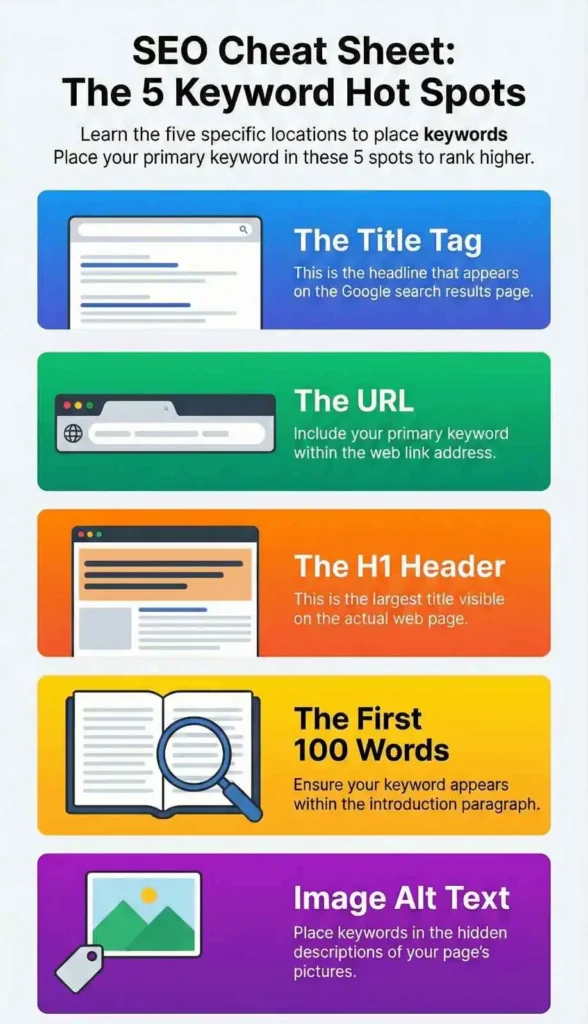
This is the core of our visual guide to keyword targeting and on page seo. You cannot just sprinkle keywords like salt on a dinner; you have to be strategic.
Imagine your web page is a newspaper front page. There are specific places where the most important news goes. Google looks at these 5 Hot Spots first to understand your page:
- The Title Tag: The headline on the Google search result.
- The URL: The web link address.
- The H1 Header: The big title on the actual page.
- The First 100 Words: The introduction paragraph.
- Image Alt Text: The hidden description of your pictures.
If your primary keyword (the main thing you want to rank for) is in these five spots, you are already ahead of 80% of websites!
3. HTML Tags: The Secret Labels
“HTML Tags” sounds like computer coding, but it is actually very simple labeling. Think of it like putting price tags on items in your shop.
The Title Tag: Your First Impression
This is the blue clickable link you see when you search on Google. It is the single most important place for your keyword.
- The Rule: Keep it under 60 characters so it doesn’t get cut off.
- The Strategy: Put your keyword at the beginning.
- Bad: “Welcome to our website where we do Physiotherapy.”
- Good: “Physiotherapy in Delhi | Best Pain Relief Clinic.”
The Meta Description: The Sales Pitch
This is the grey text under the blue link. Does it help you rank? Not directly. But it helps people click.
- Tip: Treat this like an ad. Use words like “Free Guide,” “Best Service,” or “Learn Now.”
Header Tags (H1, H2, H3): The Outline
Google reads your website like a book.
- H1 (Book Title): You generally only get one H1 per page. This tells Google the main topic. It must include your main keyword.
- H2 (Chapter Titles): These break up your page into sections. Use secondary keywords here.
- H3 (Sub-sections): These are for smaller details under the H2s.
4. Body Content: Writing for People & Robots
Now we fill the shelves. This is the main text of your article or service page.
Keyword Frequency: Don’t Be a Robot
In the old days (2010), people would write: “We offer SEO services because SEO services are good and if you want SEO services call us.” That is called Keyword Stuffing. Google hates this now.
- The 2026 Rule: Use your keyword naturally. If you write a 1,000-word article, mentioning your keyword 3 to 5 times is plenty.
LSI Keywords (The “Friend” Words)
Google is smart (it uses AI). It knows that if you are writing about “Pizza,” you should also be using words like “Cheese,” “Dough,” “Oven,” and “Slice.” These related words are called LSI Keywords (Latent Semantic Indexing). They prove to Google that you actually know your topic in depth.
E-E-A-T (Why Trust Matters)
This stands for Experience, Expertise, Authoritativeness, and Trustworthiness.
- Don’t just write fluff.
- Share real examples.
- Show that Seo Expert Service has been doing this for 25 years.
- Google prefers content written by experts, not content copied from other sites.
5. URL Structure: Your Digital Address
Your URL is the address of your house on the internet.
- Messy Address: www.seoexpertservice.com/folder1/99283/ref=22?
- Problem: Google has no idea what this page is about.
- Clean Address: www.seoexpertservice.com/visual-guide-keyword-targeting
- Benefit: Google reads the URL and immediately knows the topic.
Pro Tips for URLs:
- Keep it short.
- Use dashes (-) between words, not underscores (_).
- Include your main keyword.
6. Image SEO: Teaching Google to See
Google is a robot. It cannot “see” a picture of a cat. It only sees code. You have to tell Google, “Hey, this is a picture of a cat.”
Alt Text (Alternative Text)
This is a hidden label on every image.
- Bad Alt Text: “IMG_001.jpg”
- Good Alt Text: “Diagram showing where to put keywords on a web page.”
- Why it matters: It helps visually impaired people using screen readers, AND it helps you rank in Google Images search results.
File Names
Before you upload an image, rename it! Instead of Screenshot1.png, name it on-page-seo-guide.png. This gives Google another clue about your content.
7. The Power of Links (Internal & External)
Think of the internet like a giant spiderweb. Links are the threads that hold it all together.
Internal Links (Connecting Your Own Rooms)
These are links that go from one page on your site to another page on your site.
- Example: “Check out our [SEO Services Page] for more info.”
- Why: It helps Google’s robots crawl (travel) through your website easily. If you don’t link to a page, Google might never find it!
External Links (Citing Your Sources)
These are links that go to other websites.
- Why: Some people think sending people away is bad. But Google likes it! If you link to trusted sites (like Wikipedia or major news sites), it shows you did your research and you are helpful.
8. 2026 Special: Speed, Mobile & AI
The world has changed. In 2026, it’s not just about keywords; it’s about User Experience (UX).
Page Speed (The 3-Second Rule)
People are impatient. If your website takes more than 3 seconds to load, visitors will click the “Back” button.
- The Fix: Compress your images and use good hosting.
Mobile-First Indexing
More people search on phones than on computers. Google now looks at the mobile version of your site first. If your text is too small to read on a phone, you will not rank #1.
AEO (Answer Engine Optimization)
This is the new trend for 2026. People are asking AI chatbots and voice assistants (like Siri) questions.
- How to win: Include a “People Also Ask” or FAQ section (like the one at the end of this article) that gives short, direct answers.
9. Common Mistakes That Kill Rankings
We see these mistakes every day at Seo Expert Service. Avoid them!
- Keyword Cannibalization: This sounds scary! It means you have two different pages trying to rank for the same keyword. They end up fighting each other, and neither wins. Fix: Combine them into one strong page.
- Hidden Text: Never try to hide text by making it the same color as the background (white text on white background). Google will ban you.
- Broken Links: If a customer clicks a link and sees a “404 Error,” they lose trust. Check your links regularly.
10. Conclusion & Next Steps
Phew! We covered a lot.
We learned that On-Page SEO is about organizing your website so Google understands it. We used a visual guide to keyword targeting and on page seo to see that keywords belong in your Title, URL, Headings, and Images.
It’s not magic; it’s just digital cleaning.
But we know that running a business is hard work. You might not have time to rename image files or fix HTML tags. That is where we come in.
At Seo Expert Service, we treat your business like our own. We have the tools and the 15 years of experience to get you to #1.
Ready to get more customers?
Call Us Now:+91 85059-66000 Chat on WhatsApp: Click Here to Chat Email: bestseoexpertservice@gmail.com
People Also Ask (FAQs)
Where is the best place to put keywords for SEO?
The single most important place is your Title Tag. After that, ensure it is in your URL, H1 Header, and the first paragraph of your content.
How do I find the right keywords?
You can use tools, or simply think like your customer. What questions are they asking? Use “Long-Tail” phrases (3+ words) for the best results.
Can I just repeat my keyword 50 times?
No! That is called “Keyword Stuffing.” Google will punish your site. Use the word naturally, where it makes sense in a sentence.
How often should I update my content?
Google loves fresh content. Try to update your key pages at least once every 6 months to keep them accurate and relevant.