
If you are an SEO freelancer or run an agency, you know how hard it can be to find good clients. You might be tired of sending hundreds of cold emails and getting zero replies.
Maybe you have tried calling local businesses, but they just hang up on you. The good news is that there is a much better way to find seo clients without feeling annoying or pushy.
The secret is LinkedIn. In 2026, LinkedIn is the absolute best place to meet business owners who actually need your help.
Business owners are already on LinkedIn looking for ways to grow. They want more website traffic, and they know SEO is important.
But how do you connect with them? How do you stand out from all the other marketers?
In this complete guide, we will show you exactly how to get seo clients on linkedin step-by-step. We will cover everything from setting up your profile to closing high-paying deals.
At Seo Expert Service, we specialize in medical and physiotherapy SEO. We use these exact steps to find clinics that need our help.
In 2026, LinkedIn is not just a social network; it acts as a search engine itself, and its data is heavily scraped by AI Search tools (like Google’s AI Overviews, ChatGPT, and Claude). Optimizing your profile for specific keywords ensures you show up when business owners ask AI tools to “find top SEO experts for healthcare.
Table of Contents
Step 0: Set the Foundation Before You Reach Out (Optimize Your Profile)
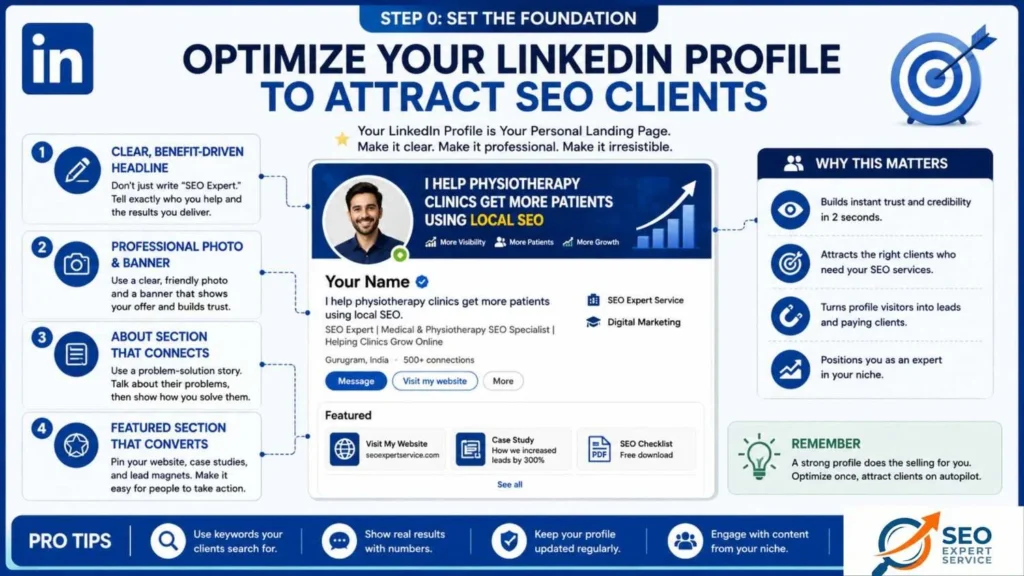
Before you talk to anyone on LinkedIn, you need to fix your profile. Think of your LinkedIn profile as your own personal landing page.
When a business owner clicks on your name, they will judge you in two seconds. You want them to instantly know what you do and how you can help them.
If your profile looks messy, they will leave. If it looks professional, they will stay and read.
Here is how you can optimize your profile to attract leads:
1. Write a Clear, Benefit-Driven Headline
Your headline is the sentence right under your name. Do not just write “SEO Expert.”
Instead, tell people exactly who you help and the amazing results you bring. For example, at Seo Expert Service, a great headline is: “I help physiotherapy clinics get more patients using local SEO.“
This makes it crystal clear. If a clinic owner sees this, they will instantly want to know more.
2. Use a Professional Photo and Banner
Your photo should be clear, bright, and friendly. Smile and look directly at the camera.
Your banner (the big picture behind your photo) should support your brand. You can use a tool like Canva to make a simple banner.
Write your main offer on the banner. Make it easy for people to see why you are the best choice.
3. Craft Your “About” Section Like a Story
Do not write a boring resume in your “About” section. Instead, use a problem-and-solution structure.
First, talk about the problems your ideal client faces. Maybe their medical website is not getting any traffic.
Then, explain how your SEO services solve that exact problem. Speak directly to your ideal client.
4. Add a “Featured” Section
LinkedIn lets you pin important links to the top of your profile. This is called the Featured section.
You should add links to your website, your best case studies, or a helpful lead magnet. Make it super easy for people to learn more about your work.
Make sure there is a clear next step. Ask them to book a call with you or download a free SEO checklist.
Customize Your LinkedIn URL & Do Keyword Research
By default, LinkedIn gives you a URL full of random numbers. Change it to something clean like linkedin.com/in/your-name-seo. Furthermore, good optimization begins with knowing what your audience actually searches for. Do keyword research for your LinkedIn profile use terms like “B2B SEO,” “Local SEO Expert,” or “Technical SEO Consultant” naturally in your headline and about section.
Step 1: Define Who You Want to Attract (Your Ideal Client)
You cannot help everyone. If you try to sell SEO to everyone, you will end up selling to no one.
You need to know exactly who you want to attract. There is no point in messaging 1,000 random people if none of them are a good fit.
You must deeply understand your ideal client, just like you understand your best friend.
Build a Client Persona
Start by making a detailed picture of your perfect client. Give them a name and a backstory.
Here are some key things you need to figure out:
- Industry: Do you want to help medical clinics, tech companies, or local plumbers?
- Location: Are you targeting people in a specific city, or globally? If you target international clients, knowing why international SEO is important will give you an edge.
- Job Title: Are you looking for the CEO, the marketing manager, or the clinic owner?
- Pain Points: What are their biggest daily challenges? What are their main goals?
- Budget: Do they make enough money to afford your services?
Focus on What You Know
At Seo Expert Service, we focus heavily on the medical and physiotherapy niche. We know their struggles.
We know they want more patient bookings. Because we understand them, our messaging is always perfect.
The clearer you are on your ideal client, the easier it becomes to write content and connect with them. You want them to feel like you are already part of their world.
Sell Outcomes, Not Just Services
A major mistake SEOs make is selling services instead of outcomes. Clients don’t buy “audits” or “backlinks” they buy more leads, higher revenue, and more patient bookings. Make sure your messaging focuses on the exact business outcome you deliver.
Step 2: Use LinkedIn’s Search Tools to Find the Right People
Once you know exactly who your perfect clients are, it is time to find them. LinkedIn has amazing search tools to help you build a targeted contact list.
You can use both the platform’s native tools and external apps like Lemlist or Waalaxy.
Using the Built-In Search Bar
Start with the normal search bar at the top of LinkedIn. You can type in simple words like “Physiotherapy Clinic Owner.”
Then, use the helpful filters. You can filter your search by location, company name, industry, and job title.
This will give you a list of people who might need your SEO help.
Using LinkedIn Sales Navigator
If you have some money to spend, LinkedIn Premium or Sales Navigator is fantastic. It gives you access to advanced filters.
You can narrow down your leads based on company size, seniority level, and years of experience.
For example, you can search for clinic owners who have a company size of 10 to 50 employees. This ensures they have the budget to pay for your Seo Expert Service packages.
Exporting Your Contacts
If your leads are already in your network, LinkedIn lets you export your contacts.
You can download a list of your connections and manage them outside of LinkedIn. This helps you keep everything organized.
The main goal is to build a high-quality list of people who perfectly match the client persona you made in Step 1.
Ready to grow your online presence?
At Seo Expert Service, we help businesses rank higher and get more traffic email us : contact@seoexpertservice.com
Step 3: Warm Up the Connection Before Messaging
Now you have a great list of potential clients. But wait! Do not send them a cold, copy-paste pitch.
Sending spam messages is a huge mistake. People hate it when a stranger tries to sell them something immediately.
Quality beats quantity, always. The smart approach is to warm up the connection before you send a direct message.
Build Trust and Familiarity
You need to build trust before you pitch. Warm-up actions are soft, casual touchpoints.
They help you show up on your prospect’s radar before you ever hit their inbox.
Here are the best ways to warm up a lead:
- Engage Consistently: Like their posts on a regular basis.
- Leave Thoughtful Comments: Do not just write “Great post!” Write a meaningful comment that adds to the conversation.
- Send a Personalized Request: When you click “Connect,” always add a personal note. Mention something you have in common.
The Goal of Warming Up
The goal is simple. By showing up in their feed over and over, you are no longer a stranger.
When you finally do send a message, they will already know who you are and what you do. They are much more likely to reply.
Step 4: Conversation to Discovery to Meeting
After they accept your connection request, it is time to start chatting. Always keep your end goal in mind.
What do you want to happen? Do you want to book a discovery call? Share a demo?
Start with Value
When you start the chat, shift gears into a value-first conversation. The goal is to build trust, not to pitch right away.
The inbox is where curiosity is sparked. It is not where the sale happens.
Ask them questions about their business. Be a friendly human being.
Tips for Better Conversations
To boost your chances of getting a phone call, follow these rules:
- Keep it Short: Make your messages human and non-pushy.
- Avoid Jargon: Do not use confusing SEO words. Speak the way your ideal client speaks.
- Use Social Proof: Share quick wins to build your credibility fast. Show them how off-page SEO impacts website rankings with your previous client data.
- End with a Low-Pressure CTA: Ask a simple question that is easy to say “yes” to.
Let your Call to Action (CTA) feel like a natural next step. You are guiding the conversation, not forcing them into a trap.
Step 5: Track Everything in a CRM or Follow-Up System
If you are talking to lots of people, you will easily forget who said what. This is why you must track your process.
Tracking your analytics is key to knowing what is working and what is not working.
Without tracking, you are just guessing. You need to know which message got the most replies and which profiles converted the best.
Use Simple Tools
You do not need fancy, expensive tools. You can start for free.
Try using Notion, as it is free and flexible. You can use Trello if you have a team.
You can even build a lightweight CRM (Customer Relationship Management) system using Google Sheets.
Organize Your Sales Stages
Take your lead list and organize everyone into clear stages:
- Contacted: You sent a message and are waiting for a reply.
- Interested: They responded nicely, but no meeting is booked yet.
- Call Scheduled: The meeting is confirmed.
- Not Interested: They gave you a clear “no”.
- No Response: You sent a message, but they never replied.
The more structured your system is, the easier it will be to scale your SEO business faster.
Need Help Tracking Your SEO Results Email Us : contact@seoexpertservice.com
Our team at Seo Expert Service provides totally transparent reporting. You will always know how your website is doing.
Build Your Personal Brand to Attract Clients Organically
Sending messages is great, but getting clients to come to you is even better. This is called organic attraction.
On LinkedIn, your personal brand is everything. It is how you become the “influencer” of your own niche.
Top creators use their personal brand to turn their profile into a client magnet.
How to Build Your Brand
To attract the right people, you need to show up constantly.
Here is how you start building a strong brand:
- Post Consistently: Share your stories, tips, and lessons learned on a regular basis.
- Show Your Personality: Add a professional photo and do not be afraid to be human in your posts.
- Optimize Your Bio: Use your profile as a landing page to make it clear who you help.
A strong personal brand builds amazing trust before you ever send a direct message.
The Importance of Consistent Content
If you want to grow your visibility, there are no shortcuts. You need to post quality content consistently.
Being consistent is not just about showing up often. It is about proving that you know what you are doing.
Why Consistency Matters
Here is why posting daily is so important:
- You Build Trust: When people see you sharing valuable insights, they trust you as a reliable voice.
- You Stay Top of Mind: In a fast-moving feed, posting keeps you visible.
- You Show Authority: The more you talk about SEO, the more people see you as the go-to expert.
- You Attract Opportunities: Simply adding value can bring you new clients and collaborations.
Plus, the LinkedIn algorithm favors users who post often and get lots of engagement.
The 30-Minute Daily Rule
Many SEO freelancers get stuck doing client work like audits, emails, and reports. They forget to hunt for new leads.
To fix this, spend just 30 minutes a day, five days a week, creating content. Share your SEO knowledge.
Talk about what you know and explain common mistakes. You do not need perfect case studies to start.
You just need clear messaging around how you help businesses. Consistent leads come from consistent visibility.
How to Write Posts That Generate Inbound Interest
There are two ways to post on LinkedIn. You can write posts that scream “I am selling something!”
Or, you can create content that naturally sparks conversations. The second option is where the magic happens.
Smart Tactics for Better Posts
Here is how you turn your content into a lead magnet without sounding pushy:
- No Direct Links: Do not put links directly in the post. Put them in the comments, because LinkedIn deprioritizes posts with external links.
- Respond Thoughtfully: Treat comments as mini-conversations. Offer to chat more via DM.
- Spark Conversation: Instead of saying “Book a call,” ask “What has been your experience?”
- DM Engagers: If someone liked your post, reach out in a friendly, non-salesy way.
- Highlight Pain Points: Talk about the real problems your ideal clients face.
- Tell Real Stories: Share how you helped a client overcome a challenge. People connect with stories.
- Make it About Them: Always frame your content around what the audience will gain.
By doing this, you will drive profile visits without ever being pushy. Connect as a human first.
What to Post: Content Ideas That Actually Attract Clients
Are you wondering what to write about? Certain types of posts perform very well because they build trust.
Here are proven formats that attract potential clients:
1. Quick Client Wins and Case Studies
These posts build credibility very fast. They show that your SEO work gets real results.
For example, show how you got a physiotherapy clinic to rank #1 on Google Maps. This helps prospects visualize what you can do for them.
2. Lessons Learned and Industry Trends
Share insights about recent Google algorithm updates. This shows you are active, informed, and reflective.
3. Actionable Tips and Frameworks
Give away value upfront. Share a 5-step checklist for optimizing a medical blog.
Giving value helps you earn trust easily.
4. Personal Stories and Values
People do not just buy services; they buy people. Share your journey or perspective.
It is okay to be vulnerable or even embarrassing. Being honest helps others connect with you on a human level.
5. Common Mistakes to Avoid
Highlight the common SEO mistakes small businesses make to show the risks of not hiring you.
Turn Failed SEO Case Studies into Teardown Content
Most agencies only publish perfect, shiny success stories. But prospects actually distrust case studies that look too clean or perfect.
Instead, try publishing “teardown content” where you openly break down SEO work that went wrong.
Be Honest About Failures
Talk about a time a website lost traffic or an experiment failed. Explain what happened, why it happened, and what you would do differently now.
This shows real lived experience and pattern recognition. Honesty about mistakes builds more trust than a fake-looking success chart.
Do’s and Don’ts for Teardowns
- Do: Show real data, even if it is uncomfortable.
- Do: Explain your decisions, not just the outcomes.
- Do: Focus on learning and recovery.
- Don’t: Disguise a failure as a “challenge” with a fake happy ending.
Buyers who reach out after a teardown usually carry scars from bad SEO agencies. When you name mistakes they recognize, the sales conversation starts halfway finished.
Write LinkedIn Articles to Boost Your LinkedIn SEO
Do not just write short posts. Publishing long-form articles on LinkedIn is a highly underrated strategy.
A well-crafted article does two powerful things at once.
First, it positions you as a total expert. When a potential client sees deep, valuable content, it builds instant trust.
Second, it works with LinkedIn’s built-in SEO. Yes, LinkedIn has its own search engine!
LinkedIn articles get indexed by search engines and show up in search results. Potential clients can find you organically without you lifting a finger.
If you are not writing articles, you are leaving visibility on the table.
A/B Test the Messages You Send
One of the best tips is to always run A/B tests on your outreach messages.
This is a simple way to figure out what actually works and improve bit by bit.
What is A/B testing? It means sending two different versions of a message to similar types of people. Then, you compare the results.
Practical Tips for A/B Testing
- Change One Thing: Change just one thing at a time, like the greeting or the call to action. This tells you exactly what made the difference.
- Measure Clearly: Decide if you are tracking the response rate, profile visits, or website clicks.
- Use Volume: Send each version to at least 10 to 15 similar profiles. Do not base your conclusions on just two replies.
- Keep Iterating: Testing is not a one-time thing. Make it a daily habit.
Struggling to manage your own SEO? Let the experts handle it Email Us : contact@seoexpertservice.com
Pitching Your SEO Services With Real Data
When you finally get on a grand-scale meeting to sell your SEO services, you must be prepared.
You need to show the prospect exactly how SEO can help their business grow. Back up your pitch with real data and current statistics.
For example, tell them that businesses with a focused SEO strategy have a 275% average ROI. That is very impressive to any business owner.
Indicate Overlooked Opportunities
Do your leads know they are missing high-value keywords? Probably not.
Impress them with short keyword lists that would boost their visibility. Show them how you can help them rank for these keywords at the top of Google.
Remind them that over 68% of online experiences start with a search engine.
Present Different Choices
SEO is not cheap, and business owners know that. Give them choices.
Offer various SEO plans, like Basic, Advanced, and Premium monthly packages. Let them choose what fits their budget.
To help potential clients understand your pricing structure, you can share resources on how to budget for SEO so they clearly see the long-term ROI
Ensure everyone is clear on what is included in each option. To speed up results, you can even couple SEO with Conversion Rate Optimization (CRO).
Offer Free SEO Audits via LinkedIn DMs
Replace pitching with diagnosis. Instead of asking for a call immediately, send a short, concrete audit directly to a prospect on LinkedIn.
If you are unsure where to start with the audit process, you can follow a detailed SEO audit checklist to ensure no critical ranking factors are missed.
Focus on visible issues. Tell them what is ranking on page one for their brand, or point out which competitors are beating them.
SEO only becomes urgent when it looks risky or expensive to ignore. A targeted audit makes the problem obvious.
How to Do Free Audits Well
- Choose Carefully: Pick prospects deliberately; do not do this at scale.
- Highlight One Issue: Focus on one or two issues with real business impact.
- Use Screenshots: Use live SERPs (Search Engine Results Pages) or a short Loom video, not confusing tool jargon.
- Ask a Question: End with a simple question, not a meeting request.
Done right, the audit feels like you are pointing out a fire alarm that no one noticed.
Use Social Proof by Showing Live Rankings
Technical audits are great, but sometimes they are too confusing for clients. Business owners might not understand SEO literacy.
Instead of showing technical errors, show them live rankings. Treat social proof as something they can verify instantly.
Make Them Search For It
Prepare a short list of keywords where your current clients already rank well. Mix up the industries and locations.
During a call, ask the prospect to open a private browser and search for those terms themselves.
The moment they spot your client on page one with their own eyes, they will stop being skeptical. Seeing live results removes doubt faster than any report.
Partner with Web Design and Dev Agencies
One of the most reliable ways to get SEO clients without doing outreach is through partnerships.
Partner with web design and development teams. These agencies work with companies right before SEO becomes an urgent need.
Why Partnerships Work
Designers speak daily with founders who need SEO. Once a new website launches, SEO issues usually pop up fast.
Maybe they have indexing gaps or a weak site structure. A warm intro from the web designer helps you get clients faster than competing on Google.
Strong agencies know their limits and will happily refer their clients to a trusted SEO expert.
How to Be a Great Partner
Target agencies that serve your ideal clients. Make it easy for them to refer you.
Explain how your monthly packages work and offer to handle technical add-ons like server-side tagging or Core Web Vitals.
You can offer them a referral fee or even do white-label work. A referral fee often costs less than paying for ads.
Publish Niche-Specific SEO Playbooks
Most people do not want generic SEO advice. They want to know how SEO fits their specific reality.
To win these clients, publish a niche-specific SEO playbook. A playbook focuses on one audience and one recurring set of problems.
Self-Qualification Tool
For example, create a playbook called “How Physiotherapy Clinics Can Win on Google in 2026.”
Explain what usually breaks, where money gets wasted, and what most providers miss.
Playbooks act as a self-qualification tool. They help clients understand their situation before a call ever happens.
When they finally reach out, the conversation shifts from “Do we need SEO?” to “How do we apply this?”.
Combine Content Marketing With Retargeting
Not everyone who visits your website will hire you on the first day. In fact, 95% of readers will leave without subscribing. This is why you must combine your content marketing with retargeting. Tell your audience how email marketing can help SEO to keep them engaged. Set up a small-spend retargeting ad campaign.
Set up a small-spend retargeting ad campaign. Leverage your best case studies to show up on their LinkedIn feed for a few weeks after they visit your site.
This keeps your brand name fresh in their mind. Soon, your amazing results will bring them back for more.
Appear on Industry Podcasts
Podcasts are exploding in popularity. In 2023 alone, over 464 million users listened to podcasts.
Marketing and SEO podcasts are a fantastic way to connect with the industry and share your knowledge.
If an opportunity presents itself to be a guest on a podcast, take it!
How to Get Invited
Do not just send a blank request. Research the show carefully.
Listen to a few episodes and create a tailor-made pitch of your story. Show the host that you can provide massive value to their listeners.
Getting SEO Clients When You Have Zero Experience
What if you are completely new? If you are just starting out and have zero freelance experience, it can feel scary.
But do not worry. There are two tried and true methods to land your very first client.
1. Tell Everyone You Know
Literally, tell everyone who will listen. Tell your family, friends, neighbors, and old coworkers that you started an SEO business.
Someone will likely give you an opportunity, even if it is for a side project. You can even set up a results-based agreement. If they make money from your SEO, you take a cut.
2. Approach Local Businesses
Find local shops in your town that are stuck on page two of Google. Approach them and offer your local SEO help.
Approaching local clients requires a specific approach; if you want a proven framework, be sure to read our complete guide on selling SEO services to local businesses.
Due to lower competition, local SEO provides very quick wins. Setting up their Google My Business could be a huge victory and give you your first real case study.
Anti-Tips: What NOT to Do (Mistakes to Avoid)
As you search for clients, you might see “gurus” giving bad advice. Here are the things you should strictly avoid doing.
Anti-Tip 1: Mass Cold Emailing Does Not Work
Sending hundreds of automated, spammy cold emails is soul-crushing work.
It takes up a huge amount of time to scrape emails. Even worse, it usually leads to prospects who know nothing about SEO and are terrible to work with.
Do not bother pitching to someone who doesn’t understand the value of what you do.
Anti-Tip 2: Targeting Generic SEO Keywords
Do not write blog posts trying to rank for generic keywords like “How to do keyword research”.
These keywords are highly competitive. Plus, your ideal client (like a clinic owner) is not searching for that.
Learn the exact pain points of your potential clients and write content that solves those specific problems.
Anti-Tip 3: Pitchslapping
Never “pitchslap” people. This means connecting with someone and instantly slapping them with a sales pitch in the first message.
This will annoy 99.9% of the people you talk to. Focus on real relationship building instead.
Conclusion: Show Up and Keep Showing Up
There is no denying that running an SEO business is challenging. Client acquisition takes time, hard work, and smart decisions.
But if you define who your client is, find where they hang out, and start showing up daily, you will win.
It might be difficult at first. But do not quit. Perseverance and consistency are all that matters. Start posting on LinkedIn today, and you won’t regret it.
At Seo Expert Service, we know exactly how to drive massive traffic and grow businesses. If you want to skip the hard work and get guaranteed results, let our team help you.
Also Read : Why Does SEO Take So Long?
Frequently Asked Questions (FAQs)
How do I add clients on LinkedIn?
Start by sending a personalized connection request. Mention something relevant, like a post they shared. Keep it friendly, and build a relationship before pitching.
How do I attract more people on LinkedIn?
Consistency is key. Post valuable content that speaks to your ideal client’s goals. Engage meaningfully with other people’s posts.
Is LinkedIn good for getting clients?
Absolutely. When used strategically, LinkedIn is powerful for connecting with decision-makers and building authority. The key is to offer value first.
How do I prospect clients on LinkedIn?
Identify your ideal clients using LinkedIn search filters or Sales Navigator. Engage with their content, send a thoughtful request, and start a value-driven conversation.
Is it OK to add clients on LinkedIn?
Yes, it is a great idea. Connecting with existing clients strengthens your relationship, brings referrals, and increases the reach of your posts.
How to pitch on LinkedIn?
Do not cold pitch right after connecting. Warm them up with value. When you do pitch, be brief, personalized, and ask permission to share more.