
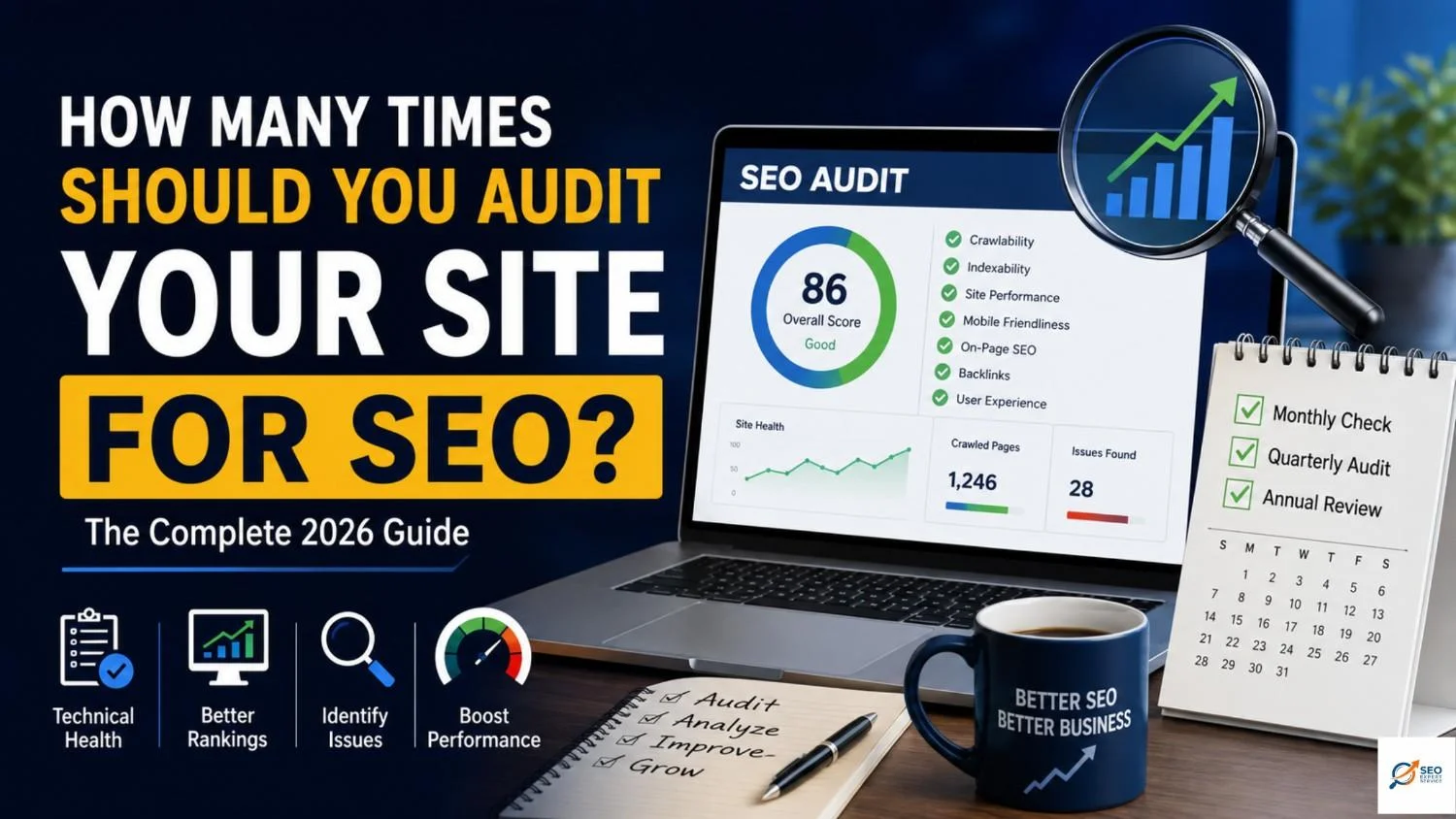
How Many Times Should You Audit Your Site for SEO? (2026 Guide)
If you are wondering how many times you should audit your site for SEO, here is the direct answer: Most websites require a comprehensive SEO audit every 3 to 6 months, along with a quick 15-minute health check every month.
(Key Takeaways):
- Small/Local Sites: Full audit every 6 months.
- Blogs/Active Sites: Quarterly deep audits.
- eCommerce/Enterprise: Monthly technical checks & Quarterly full audits.
- Emergency Audits: Required immediately after a traffic drop, site migration, or a major Google Core Update.
SEO is not a one-and-done task. With Google releasing over 4,000 algorithm changes annually and the introduction of AI Overviews, your website needs constant servicing. If you ignore maintenance, technical bloat and content decay will slowly destroy your search rankings.
Think of your website like a car. Even if it runs perfectly today, it still needs regular servicing. If you ignore maintenance for too long, the car will eventually develop problems. Your website works the same way. Regular SEO audits help you find and fix issues before they affect your traffic and business growth.
Many people believe an SEO audit is only for websites with problems. That isn’t true. Even websites ranking on the first page of Google need regular audits to maintain their position. Search engines constantly change their ranking factors, and businesses that stay updated usually remain ahead of their competitors.
In this detailed guide, you’ll learn exactly how many times should you audit your site for SEO, what factors affect audit frequency, when you should perform an immediate audit, what an SEO audit should include, and how regular audits can improve your website’s performance in 2026 and beyond.
Whether you own a small business website, an eCommerce store, a company website, or a large enterprise portal, this guide will help you choose the right SEO audit schedule without wasting time or money.
Expert Tip from Seo Expert Service
The best SEO strategy isn’t just about publishing more content. It’s about making sure your existing website stays healthy, fast, user-friendly, and fully optimized. Regular SEO audits make that possible.
Table of Contents
Want a Professional SEO Audit?
At Seo Expert Service, we perform in-depth SEO audits that uncover technical issues, content gaps, keyword opportunities, and ranking problems before they impact your business.
If you’re unsure whether your website is performing at its best, our SEO experts can help email us : contact@seoexpertservice.com
What Is an SEO Audit?
An SEO audit is a complete health check of your website. It helps you understand how well your website is performing in search engines like Google and what improvements are needed to rank higher.
Think of it like a regular medical check-up. Even if you feel healthy, a doctor can still find small problems before they become serious. An SEO audit works the same way. It finds hidden issues that may stop your website from reaching more people online.
A proper SEO audit doesn’t only look at keywords. It checks your website’s speed, mobile friendliness, content quality, technical errors, user experience, backlinks, security, and many other ranking factors. The goal is to make sure your website is easy for both users and search engines to understand.
Google wants to show websites that are fast, trustworthy, useful, and easy to navigate. If your website has broken links, slow pages, duplicate content, or outdated information, Google may rank your competitors higher instead. That’s why regular SEO audits are so important.
Today, SEO is changing faster than ever. Google’s AI-powered search, AI Overviews, voice search, and generative search engines now focus more on helpful content than keyword stuffing. A modern SEO audit helps your website stay ready for these changes.
Simply put, an SEO audit tells you what is working well, what needs improvement, and what opportunities you can use to get more organic traffic. To make this process seamless, following a comprehensive SEO audit checklist ensures you never miss a critical ranking factor.
Why Is an SEO Audit Important?
Many business owners think SEO is only about adding keywords to a webpage. In reality, SEO is much bigger than that. Your website can have great content, but if technical issues prevent Google from understanding your pages, your rankings may still suffer.
Did you know that according to industry data from Ahrefs, a staggering 96.55% of all web pages receive zero organic traffic from Google? This happens primarily due to technical errors, orphan pages, and Content Decay.
Content decay means your articles naturally lose relevance over time (decaying at an estimated 1.21% per week) as competitors publish fresher content. A routine audit identifies this decay, allowing you to refresh outdated pages, fix keyword cannibalization, and reclaim your lost rankings.
An SEO audit helps you discover these hidden problems before they become expensive. Small issues like slow loading speed, missing meta descriptions, broken internal links, or indexing errors may not seem serious, but together they can reduce your visibility in search results.
Another reason SEO audits are important is that Google updates its ranking algorithm regularly. Some updates are small, while others can significantly affect website rankings. If you never audit your website, you may not even realize why your traffic suddenly dropped.
SEO audits also help improve user experience. Visitors expect websites to load quickly, work smoothly on mobile devices, and provide useful information. When users enjoy browsing your website, they stay longer, explore more pages, and are more likely to become customers. Google notices these positive signals and often rewards them with better rankings.
For businesses, regular SEO audits also save money in the long run. If you are figuring out how to budget for SEO as a business, remember that fixing a few small technical issues today is much easier and cheaper than recovering from a major ranking drop later.
Most importantly, an SEO audit gives you a clear roadmap. Rather than guessing what to improve, you’ll know exactly which pages need updates, which keywords deserve more attention, and which technical fixes can make the biggest impact.
What Does an SEO Audit Actually Check?
A complete SEO audit looks at every important part of your website instead of focusing on only one area. Every section works together to improve your search rankings and overall website performance.
The first area is technical SEO. If you are wondering how do you perform a technical SEO audit, it basically includes checking website speed, mobile responsiveness, HTTPS security, XML sitemaps, crawl errors, indexing issues, Core Web Vitals, and broken links. If Google cannot properly crawl your website, your content may never appear in search results.
The second area is on-page SEO. Here, the audit reviews your title tags, meta descriptions, heading structure, image optimization, internal linking, URL structure, and keyword placement. These elements help search engines understand what each page is about.
Next comes content quality. The audit checks whether your articles answer user questions, match search intent, provide updated information, and follow Google’s E-E-A-T principles. Thin, duplicate, or outdated content can reduce your rankings, while high-quality content builds trust with both users and Google.
The audit also examines off-page SEO, including your backlink profile, referring domains, and website authority. High-quality backlinks from trusted websites strengthen your reputation, while spammy links can negatively affect your rankings.
Finally, a good SEO audit evaluates user experience. It looks at navigation, page layout, readability, mobile usability, and how easily visitors can find information. A website that is simple to use usually performs better in search engines because it creates a better experience for users.
Why SEO Audits Matter More in 2026
SEO has changed dramatically over the past few years. Ranking on Google is no longer just about using the right keywords. Search engines now evaluate whether your content genuinely helps people and provides trustworthy answers.
With AI Overviews, voice search, ChatGPT, Gemini, Perplexity AI, and other AI-powered search platforms becoming more common, websites need to focus on clarity, expertise, and user experience. Regular SEO audits help ensure your content is ready for both traditional search engines and AI-driven search results.
Modern SEO also emphasizes page speed, mobile performance, accessibility, structured data, and content freshness. Even a well-ranking page can slowly lose visibility if it isn’t updated or optimized over time.
Businesses that audit their websites regularly can quickly identify new opportunities, adapt to Google’s latest updates, and stay ahead of competitors who only react after losing rankings.
At Seo Expert Service, we recommend treating SEO audits as a regular part of your digital marketing strategy—not as a one-time task. A healthy website is more likely to attract visitors, generate leads, and achieve long-term success.
Need a Professional SEO Audit?
Seo Expert Service provides comprehensive SEO audits that uncover technical issues, improve rankings, and increase organic traffic.
If you’re unsure whether your website is fully optimized, let our experts help : contact@seoexpertservice.com
How Many Times Should You Audit Your Site for SEO?
Here is a quick reference table to determine your ideal SEO audit frequency based on your website type:
| Website Type | Quick Health Check | Deep Technical Audit |
| Small Business / Local | Monthly | Every 6 Months |
| Blogs / Content Sites | Monthly | Quarterly (Every 3 Months) |
| eCommerce Stores | Bi-Weekly | Monthly / Quarterly |
| Enterprise / News Sites | Weekly | Monthly |
Instead of asking “How many times should you audit your site for SEO?”, ask yourself: “How often does my website’s content and structure change?” The faster you grow, the more frequently you need an audit.
If you’re wondering how many times should you audit your site for SEO, the short answer is this: most websites should perform a complete SEO audit every 3 to 6 months, along with a quick monthly SEO health check. However, there is no single schedule that works for every website.
The right audit frequency depends on several factors, such as your website size, how often you publish content, how competitive your industry is, and whether you’ve recently made major changes to your website.
For example, a local business website with only a few pages usually doesn’t need monthly deep audits. On the other hand, an eCommerce store with thousands of products should be monitored much more frequently because products, categories, and pages change regularly.
Instead of asking “How many times should you audit your site for SEO?”, a better question is “How often does my website change?” The faster your website grows, the more often it should be audited.
At Seo Expert Service, we generally recommend a layered approach. Perform a quick SEO health check every month, carry out a detailed technical audit every quarter, and complete a full website SEO audit at least once every year. This strategy helps you catch small problems early before they become serious ranking issues.
There Is No One-Size-Fits-All SEO Audit Schedule
One of the biggest misconceptions about SEO is believing that a website only needs one audit after launch. In reality, SEO is an ongoing process because Google never stops evolving.
Every year, Google rolls out multiple Core Updates, introduces new ranking signals, and improves how it understands content. At the same time, your competitors are publishing fresh articles, earning backlinks, and improving their websites. If your website stays unchanged for months, it can slowly lose its competitive advantage.
That’s why successful businesses don’t treat SEO audits as a one-time task. Instead, they make audits part of their regular website maintenance strategy.
Imagine two businesses in the same industry. The first business audits its website every few months, fixes technical errors, updates old content, and improves page speed. The second business ignores its website for an entire year. Which one is more likely to rank higher? The answer is obvious.
Regular SEO audits help your website stay healthy, competitive, and aligned with Google’s latest ranking requirements.
What Is the Best SEO Audit Frequency?
The ideal SEO audit frequency depends on the type of audit you’re performing. Not every audit needs to be a full-day technical review. Some checks only take a few minutes, while others require a detailed analysis of your entire website.
A monthly SEO health check is perfect for monitoring traffic, checking Google Search Console, identifying crawl errors, reviewing Core Web Vitals, and making sure nothing unexpected has gone wrong. These small checks prevent minor issues from becoming major problems.
Every three months, it’s a good idea to perform a more detailed technical SEO audit. This includes reviewing page speed, internal links, indexing, metadata, duplicate content, schema markup, and other important technical factors.
Once or twice a year, you should complete a comprehensive SEO audit that covers technical SEO, on-page optimization, content quality, backlink analysis, competitor research, user experience, and your overall SEO strategy. This yearly review helps identify long-term opportunities for growth.
When these three audit levels work together, your website stays optimized throughout the year instead of only receiving attention when traffic starts dropping.
Factors That Affect How Often You Should Audit Your Website
Although general recommendations are helpful, your website may need a different audit schedule depending on its unique situation. Several important factors influence how frequently you should review your SEO performance.
Trigger Events: When to Audit Immediately (Off-Schedule)
Sometimes, you cannot wait for your quarterly scheduled review. You must perform an emergency SEO audit if you experience any of these “Trigger Events”:
- Sudden Traffic or Ranking Drop: If traffic falls by 20% or more overnight.
- Website Redesign or CMS Migration: Crucial to avoid broken links and redirect chain disasters.
- After a Google Core Update: To see if your site aligns with the latest E-E-A-T guidelines.
- Domain Name Change: To ensure your crawl budget is optimized and 301 redirects are passing link equity correctly.
Website Size Matters
The size of your website has a direct impact on how often it should be audited.
A small website with ten or twenty pages is much easier to maintain than a website with hundreds or thousands of pages. Fewer pages usually mean fewer technical issues, fewer broken links, and less content that needs updating.
Large websites are completely different. Every time new pages are published, products are added, or categories change, new SEO issues can appear. That’s why larger websites require much more frequent SEO monitoring.
As your website grows, your SEO audit schedule should become more frequent to match its complexity.
How Often You Publish Content
Content is one of the strongest ranking factors in modern SEO. If your business publishes new blog posts every week, updates service pages regularly, or adds new landing pages, your website changes constantly.
Each new page creates another opportunity for technical issues, keyword cannibalization, duplicate content, or internal linking problems. Regular audits help ensure all new content follows SEO best practices.
On the other hand, if your website rarely changes, quarterly or biannual audits may be enough to maintain strong performance.
Competition in Your Industry
Some industries are extremely competitive. Businesses are constantly creating content, building backlinks, improving user experience, and investing in SEO.
If you’re competing in industries like healthcare, digital marketing, finance, legal services, or eCommerce, your competitors are probably updating their websites every week. Waiting six months between SEO audits could allow competitors to overtake your rankings.
In competitive industries, regular SEO audits help you identify new opportunities, respond to market changes, and maintain your search visibility before competitors gain an advantage.
Website Redesign or Migration
One of the biggest reasons websites lose traffic is a poorly managed redesign or migration.
Changing your website’s design, switching CMS platforms, updating URLs, or moving to a new domain can accidentally create broken links, missing redirects, duplicate pages, or indexing issues.
That’s why SEO audits should always be performed before launching major website changes and immediately after those changes go live. Catching technical problems early can prevent months of lost rankings.
Google Algorithm Updates
Google continuously updates its search algorithm to improve search quality.
Sometimes these updates are small, while major Core Updates can significantly change rankings across many industries. If your website experiences noticeable ranking changes after an update, an SEO audit should be your first step.
Instead of guessing what happened, an audit helps identify whether the issue is technical, content-related, or caused by changes in Google’s ranking systems.
Businesses that monitor algorithm updates and audit their websites regularly recover much faster than those who ignore these changes.
Sudden Traffic Drops
A sudden drop in website traffic should never be ignored.
Traffic losses can happen because of indexing problems, technical errors, broken pages, manual penalties, outdated content, or increased competition. Waiting until your next scheduled audit may allow these issues to become much worse.
Whenever your organic traffic declines unexpectedly, perform a complete SEO audit as soon as possible. The faster you identify the cause, the easier it is to recover your rankings.
Business Goals Also Influence Audit Frequency
Your SEO strategy should always match your business goals.
If you’re planning to launch a new service, enter a new city, target additional keywords, or increase online sales, you’ll need more frequent SEO audits to monitor progress and measure results.
Businesses investing heavily in digital marketing should treat SEO audits as a regular business activity rather than an occasional maintenance task.
The more important organic traffic is to your business, the more attention your website deserves.
Expert Recommendation from Seo Expert Service
After working with businesses across different industries, we’ve found that the safest and most effective SEO audit schedule is surprisingly simple.
Start each month with a quick SEO health check to monitor traffic, crawl errors, and website performance. Every three months, perform a detailed technical SEO audit to identify hidden issues before they impact rankings. Finally, complete one comprehensive SEO audit every year to review your entire SEO strategy, update older content, analyze competitors, and prepare for future Google updates.
This balanced approach keeps your website healthy throughout the year while avoiding unnecessary work.
Ready to Improve Your Website’s SEO?
We’ll identify technical issues, uncover ranking opportunities, and provide a clear action plan to improve your organic visibility.
If you want expert guidance, Seo Expert Service can perform a complete SEO audit tailored to your business email us : contact@seoexpertservice.com
SEO Audit Schedule Based on Website Type
Now that you know there isn’t a single answer to how many times should you audit your site for SEO, let’s look at the different types of websites. Every website is different, and the ideal SEO audit schedule depends on how often your website changes, how many pages it has, and how competitive your industry is.
A local business website doesn’t need the same level of SEO maintenance as a large eCommerce store. Similarly, a personal blog has different SEO needs than a news website that publishes dozens of articles every day.
Understanding your website type will help you create an SEO audit schedule that saves time while keeping your rankings strong.
Small Business Websites
Small business websites usually have between 10 and 50 pages. These websites don’t change very often and mainly focus on showcasing services, contact information, and a few important landing pages.
Because the website structure remains stable for long periods, a complete SEO audit every 3 to 6 months is usually enough. However, performing a quick monthly SEO health check is still recommended. This allows you to catch indexing issues, broken links, or sudden ranking drops before they affect your business.
For local businesses such as dentists, physiotherapy clinics, small law firms, consultants, and home service providers, maintaining consistent SEO performance is often more important than publishing large amounts of new content.
Why Small Businesses Still Need Regular SEO Audits
Many small business owners think their website is “too small” to need regular SEO maintenance. Unfortunately, Google doesn’t rank websites based on size it ranks them based on quality and user experience.
Even a 15-page website can lose rankings if pages become slow, metadata goes missing, images aren’t optimized, or competitors improve their websites. Regular audits help identify these issues before they start affecting lead generation.
For most small businesses, consistency is the key to long-term SEO success.
Blog Websites
Blogs are constantly growing because new articles are published regularly. Every new blog post creates another opportunity to rank for valuable keywords, but it also increases the chances of duplicate content, outdated articles, keyword cannibalization, and internal linking issues.
If you publish one or two articles each month, performing a complete SEO audit every quarter is usually enough. However, if your blog publishes content every week, you should review your SEO performance every month to ensure all pages remain optimized.
Older blog posts also deserve attention. Refreshing outdated articles, updating statistics, improving headings, and adding new internal links can often improve rankings faster than creating entirely new content.
Content Decay Is Real
Many bloggers focus only on publishing new articles while ignoring older ones. Over time, even high-ranking content can become outdated as competitors publish newer and more detailed information.
A regular content audit helps you identify articles that need refreshing. Updating existing content is often one of the easiest ways to increase organic traffic without writing from scratch.
This is why successful blogs treat SEO audits as part of their content strategy instead of viewing them as technical tasks.
eCommerce Websites
eCommerce websites require much more frequent SEO audits than almost any other type of website. Products are constantly added, removed, updated, or marked as out of stock. Categories change, URLs are modified, and seasonal promotions create new landing pages throughout the year.
Because so much changes, an eCommerce website should receive a light SEO health check every month and a detailed technical audit every quarter. Large online stores may even benefit from monthly technical reviews to ensure everything continues working correctly.
Ignoring SEO maintenance on an online store can quickly lead to indexing problems, duplicate product pages, broken internal links, or missing product schema all of which can reduce visibility in Google Search.
Why SEO Audits Are Critical for Online Stores
Every product page is an opportunity to generate revenue. If even a small percentage of product pages stop appearing in search results because of technical issues, the financial impact can be significant.
SEO audits help online stores identify crawl errors, improve page speed, optimize category pages, fix duplicate content, and ensure product pages remain visible in Google’s search results.
For growing eCommerce businesses, regular SEO audits are not optional they’re an essential part of maintaining online sales.
Enterprise Websites
Enterprise websites often contain hundreds or even thousands of pages spread across multiple categories, departments, or geographic locations. Managing SEO at this scale is much more challenging than maintaining a small business website.
Large websites generate technical issues more frequently simply because they contain so much content. Broken links, orphan pages, duplicate URLs, indexing problems, and crawl budget issues become increasingly common as websites expand.
For enterprise businesses, a monthly SEO review combined with quarterly deep technical audits is usually the most effective strategy. Annual audits should also include competitor analysis, content gap research, and long-term SEO planning.
Large Websites Need Continuous Monitoring
As websites grow, even minor technical issues can affect hundreds of pages simultaneously. Waiting six months to identify these problems can result in significant ranking losses.
Large organizations benefit from ongoing SEO monitoring because it allows technical teams to fix problems before they spread across the website.
Instead of performing one massive audit every year, enterprise websites achieve better results through smaller, consistent audits throughout the year.
Local Business Websites
Local businesses rely heavily on appearing in Google Search and Google Maps when nearby customers search for their services. Line: Because local search results can change quickly, regular SEO audits are especially valuable to get more local business leads with SEO.
A local SEO audit should include reviewing your Google Business Profile, checking that your business name, address, and phone number are consistent across all directories, monitoring customer reviews, and ensuring local landing pages remain optimized.
Most local businesses should perform a full local SEO audit every three to four months while checking their Google Business Profile monthly for updates or customer feedback.
Local SEO Requires More Than Keywords
Many business owners believe local SEO only involves adding city names to their website. In reality, Google evaluates many additional factors, including customer reviews, local citations, business categories, proximity, and overall website quality.
Regular audits ensure all of these signals continue supporting your local rankings instead of working against them.
News and Media Websites
News websites publish content almost every day, sometimes multiple times each hour. Because content changes so quickly, technical SEO problems can appear without warning.
Publishers should review indexing, crawl errors, structured data, Core Web Vitals, and content performance every month. Larger news organizations often monitor SEO daily to ensure breaking stories are indexed immediately.
Content freshness is one of the biggest ranking factors for news websites, making continuous SEO monitoring essential.
SaaS and Technology Websites
Software companies frequently launch new features, update landing pages, publish product documentation, and create educational content. Every update creates opportunities for new rankings but also introduces potential SEO risks.
Quarterly technical audits combined with monthly performance reviews help SaaS companies maintain strong visibility while ensuring their product pages continue matching user search intent.
Regular audits also help identify opportunities to create comparison pages, feature guides, and knowledge-base articles that attract highly targeted organic traffic.
Which SEO Audit Schedule Is Best?
The perfect SEO audit schedule isn’t based on guesswork. It’s based on how often your website changes and how important organic traffic is to your business.
If your website rarely changes, auditing every few months may be enough. But if you’re constantly adding new content, launching products, or competing in a crowded industry, your SEO should be reviewed much more often.
The most successful businesses don’t wait until rankings drop before checking their SEO. They follow a proactive schedule that keeps their website healthy all year long.
At Seo Expert Service, we recommend choosing an audit schedule based on your website’s size, growth, and business goals not simply following a fixed calendar.
Keep Your Website Performing at Its Best
Whether you run a small business website, an online store, or a large enterprise platform, regular SEO audits can help you find hidden issues before they impact your rankings and revenue.
Our team at Seo Expert Service performs detailed website audits that improve search visibility, user experience, and long-term organic growth email us : contact@seoexpertservice.com
Monthly vs Quarterly vs Annual SEO Audits
One of the biggest questions businesses ask after learning how many times should you audit your site for SEO is whether they need monthly, quarterly, or yearly audits.
The answer is that each type of audit serves a different purpose. A monthly audit helps you catch small problems before they grow. A quarterly audit allows you to fix technical and content issues on a regular basis. An annual audit gives you a complete picture of your website’s overall SEO performance and future opportunities.
Instead of choosing only one type, successful businesses combine all three. This layered approach keeps the website healthy throughout the year while ensuring long-term SEO growth.
Monthly SEO Audits
A monthly SEO audit is like giving your website a quick health check. It doesn’t require reviewing every single page, but it helps you confirm that everything is working properly.
During a monthly audit, you should review your organic traffic, keyword rankings, indexing status, crawl errors, and Core Web Vitals. You should also check whether recently published pages have been indexed correctly and whether any important pages have suddenly lost rankings.
Monthly audits are especially valuable because SEO problems often appear without warning. A broken page, accidental no-index tag, server error, or indexing issue can reduce your traffic within days if it goes unnoticed.
Spending just a little time each month reviewing your website can prevent much larger problems in the future.
Who Should Perform Monthly SEO Audits?
Monthly SEO audits are ideal for websites that publish content regularly or depend heavily on organic traffic.
If you run an online store, a growing blog, a SaaS website, or a business that generates leads through Google Search, monthly audits help you stay ahead of technical issues and competitor activity.
Even small businesses benefit from monthly check-ins because they provide peace of mind that the website is performing as expected.
Quarterly SEO Audits
A quarterly SEO audit goes much deeper than a monthly review. Instead of only monitoring performance, you begin analyzing the technical foundation of your website.
Every three months, you should examine page speed, mobile usability, internal linking, duplicate content, redirect issues, structured data, metadata, XML sitemaps, and crawlability.
Quarterly audits also provide an excellent opportunity to review older content. You may discover articles that need updating, service pages that require additional information, or keywords that are beginning to lose rankings.
Completing these improvements every few months helps maintain steady SEO growth rather than allowing problems to accumulate over time.
Why Quarterly Audits Produce Better Results
Many SEO problems develop gradually. A page might slowly lose traffic because competitors publish better content. Internal links may become outdated after new pages are added. Older blog posts can lose relevance as industry information changes.
Quarterly audits help identify these slow-moving issues before they significantly affect rankings.
Instead of waiting until website performance drops dramatically, businesses can make small improvements every few months and maintain consistent organic growth.
Annual SEO Audits
An annual SEO audit is the most comprehensive review of your website. Instead of focusing only on technical issues, it evaluates your entire SEO strategy.
During this audit, you review every important aspect of your website, including technical SEO, content quality, backlink profile, keyword performance, user experience, competitor strategies, local SEO, and overall business goals.
An annual audit also helps you measure progress over the past year. You can identify which pages generated the most traffic, which keywords performed best, and which areas need additional investment moving forward.
Think of your annual SEO audit as creating a roadmap for the next twelve months.
Why Every Business Needs an Annual SEO Audit
Even websites that perform well can benefit from an annual review.
Google’s ranking factors continue evolving every year, and customer search behavior also changes. Content that ranked well last year may no longer answer today’s search intent.
An annual audit allows you to refresh your strategy, remove outdated content, identify new keyword opportunities, and prepare your website for future growth.
Businesses that perform annual SEO reviews are usually much better prepared for Google Core Updates than businesses that ignore long-term planning.
Different Types of SEO Audits
A complete SEO audit isn’t just one report. It includes several specialized audits that examine different parts of your website.
Each audit focuses on a specific area, and together they provide a complete picture of your website’s SEO health.
Technical SEO Audit
Technical SEO is the foundation of every successful website. Even the best content cannot rank well if search engines cannot properly crawl or index your pages.
A technical SEO audit examines your website’s loading speed, mobile responsiveness, HTTPS security, XML sitemap, robots.txt file, crawl errors, indexing status, structured data, canonical tags, redirect chains, broken links, and Core Web Vitals.
When technical issues remain unresolved, they often prevent search engines from fully understanding your website. Fixing these problems improves both search visibility and user experience.
For most businesses, a detailed technical SEO audit should be performed every three months.
On-Page SEO Audit
On-page SEO focuses on everything users and search engines see directly on your webpages.
This audit reviews title tags, meta descriptions, heading structure, keyword placement, image optimization, internal links, URL structure, schema markup, and overall content organization.
A well-optimized page makes it easier for Google to understand your content while helping visitors quickly find the information they need.
Regular on-page audits also identify opportunities to improve click-through rates by updating page titles and meta descriptions.
Content SEO Audit
Content is one of the strongest ranking factors in modern SEO, but even excellent content becomes outdated over time.
It identifies outdated content, thin pages, keyword cannibalization, and missing content opportunities. A proper audit also highlights why is having duplicate content an issue for SEO, allowing you to fix these errors before they hurt your rankings.
Instead of always writing new articles, businesses often achieve better results by improving existing content.
Updating statistics, adding expert insights, improving readability, and expanding older articles can significantly increase rankings without starting from scratch.
Off-Page SEO Audit
Your website’s authority doesn’t depend only on what happens on your website. It also depends on how other websites interact with it.
An off-page SEO audit analyzes your backlink profile, referring domains, anchor text distribution, brand mentions, and overall domain authority.
The goal is to identify harmful backlinks, discover new link-building opportunities, and strengthen your website’s credibility.
High-quality backlinks remain one of Google’s strongest ranking signals, making regular off-page audits an essential part of long-term SEO success.
Web Accessibility Audit (ADA Compliance & UX)
In 2026, accessibility is no longer optional; it directly impacts user experience (UX) and SEO. An accessibility audit ensures your website can be navigated by users with disabilities (using screen readers, keyboard navigation, etc.).
Real-World Impact: When Tesco invested £35,000 to rebuild their website for accessibility, their online revenue jumped to £13 million annually. Fixing low color contrast, missing alt text, and semantic HTML structure not only helps disabled users but allows Google’s bots to understand your site architecture perfectly.
User Experience (UX) Audit
Google wants users to enjoy browsing websites. If visitors struggle to navigate your pages, search engines may interpret this as a poor user experience.
A UX audit examines navigation, readability, mobile usability, page layout, button placement, accessibility, and overall visitor satisfaction.
When users stay longer, visit multiple pages, and easily find the information they’re looking for, Google receives positive engagement signals that can support higher rankings.
Improving user experience benefits both SEO performance and conversion rates.
Local SEO Audit
For businesses serving local customers, local SEO deserves special attention.
A local SEO audit reviews your Google Business Profile, business citations, customer reviews, local keywords, map visibility, and consistency of your business information across the internet.
Even small inconsistencies in your business name, address, or phone number can reduce local search visibility.
Regular local SEO audits help businesses maintain strong rankings in Google Maps and local search results.
Competitor SEO Audit
Understanding your competitors is just as important as understanding your own website.
A competitor SEO audit examines which keywords competitors rank for, the type of content they publish, how they earn backlinks, and what strategies help them attract organic traffic.
This analysis often reveals keyword opportunities, content gaps, and areas where your website can outperform competing businesses.
Rather than copying competitors, the goal is to create more valuable, helpful, and comprehensive content that gives users a better experience.
Why Combining All These Audits Matters
No single SEO audit tells the complete story.
A technically perfect website may still struggle because of weak content. Great content may fail because of poor page speed. Strong backlinks cannot fully compensate for indexing problems.
That’s why professional SEO focuses on combining technical SEO, on-page optimization, content quality, user experience, local SEO, and competitor analysis into one complete strategy.
At Seo Expert Service, we believe SEO works best when every part of your website improves together. Small improvements across multiple areas often produce much better results than focusing on only one aspect of SEO.
Let Experts Audit Your Website
Our specialists at Seo Expert Service perform comprehensive audits that uncover hidden issues, improve rankings, and help your business attract more qualified organic traffic.
Not sure which type of SEO audit your website needs email us : contact@seoexpertservice.com
The 15-Minute DIY Audit & Monitoring vs. Auditing
Monitoring vs. Auditing: What’s the Difference?
Keep in mind that automated SEO tracking (like getting Ahrefs or Semrush alerts) is Monitoring. It is continuous. Auditing, however, is a deep, manual, strategic review done by a human expert.
The 15-Minute DIY SEO Audit Routine
Want to check your site’s health right now? Follow this quick framework:
- Check Indexability: Open Google Search Console -> Go to ‘Pages’ -> Look for a spike in “Not Indexed” errors.
- Check Core Web Vitals: Run your top 5 money pages through PageSpeed Insights. Check for high Interaction to Next Paint (INP) and slow Largest Contentful Paint (LCP).
- Index Bloat Check: Go to Google and search site:yourdomain.com. If the number of results is vastly higher than your actual page count, you have a duplicate content or tag-page indexation issue.
Best SEO Audit Tools in 2026
Performing an SEO audit becomes much easier when you use the right tools. While experience is always important, SEO tools help you collect accurate data, identify technical problems, monitor rankings, and discover opportunities to improve your website.
Some tools are perfect for beginners, while others are designed for SEO professionals who manage large websites. The good news is that you don’t need expensive software to start auditing your website. Even free tools from Google can provide valuable insights into your site’s performance.
Below are some of the most trusted SEO audit tools that businesses use in 2026.
Google Search Console
Google Search Console is one of the most important free SEO tools available. It shows how Google views your website and helps you monitor indexing, crawl errors, keyword performance, page experience, and Core Web Vitals.
If Google cannot crawl or index one of your pages, Search Console is usually the first place where you’ll find that information. It also shows which search queries bring visitors to your website and highlights pages that may need improvement.
Every website owner should review Google Search Console regularly because it provides direct information from Google itself.
Google Analytics 4 (GA4)
Google Analytics helps you understand how visitors interact with your website after they arrive.
It provides detailed information about user behavior, traffic sources, engagement, conversions, and popular pages. During an SEO audit, Analytics helps identify pages with high bounce rates, declining traffic, or poor user engagement.
These insights allow you to improve content and create a better experience for your visitors.
Ahrefs
Ahrefs is one of the most powerful SEO tools for backlink analysis and competitor research.
It helps you discover which websites link to your content, which keywords your competitors rank for, and where new link-building opportunities exist.
Ahrefs is also excellent for finding broken backlinks, analyzing domain authority, and identifying content gaps that could increase your organic traffic.
Semrush
Semrush is an all-in-one SEO platform that combines keyword research, competitor analysis, technical SEO auditing, backlink monitoring, and content optimization.
Many businesses use Semrush because it provides a complete overview of website performance in one dashboard.
Its Site Audit feature quickly identifies technical issues while offering practical recommendations for improving overall SEO health.
Screaming Frog SEO Spider
Screaming Frog is a favorite tool among technical SEO professionals.
It crawls your website just like a search engine and identifies broken links, duplicate content, missing title tags, redirect chains, crawl errors, orphan pages, and many other technical issues.
For medium and large websites, Screaming Frog provides valuable information that is difficult to collect manually.
PageSpeed Insights
Website speed is now one of Google’s most important ranking signals.
PageSpeed Insights measures loading performance on both desktop and mobile devices while providing suggestions to improve Core Web Vitals.
Slow-loading websites often lose visitors before pages even finish loading. Regular speed testing helps maintain both user experience and SEO performance.
Build a Simple SEO Audit Routine
Many businesses think SEO audits require dozens of hours every month. In reality, having a simple routine is much more effective than performing one massive audit each year.
By breaking your SEO activities into monthly, quarterly, and annual tasks, your website remains healthy throughout the year without becoming overwhelming.
Let’s look at a practical schedule that almost every business can follow.
Monthly SEO Health Check
A monthly SEO review doesn’t need to take an entire day. The goal is simply to confirm that your website is performing normally and that no unexpected issues have appeared.
Start by reviewing your organic traffic in Google Analytics. Compare current performance with the previous month and look for unusual drops or sudden increases.
Next, open Google Search Console to check whether new crawl errors, indexing problems, or mobile usability issues have appeared. Reviewing your Core Web Vitals each month also helps identify performance problems before they affect rankings.
Finally, review your most important keywords to confirm they continue performing well. Small ranking fluctuations are normal, but significant declines should be investigated immediately.
Performing these simple checks every month helps prevent small technical issues from becoming major SEO problems.
Quarterly SEO Audit
Every three months, it’s time to perform a much deeper review of your website.
This audit should include analyzing technical SEO, updating older content, reviewing internal links, checking duplicate pages, evaluating page speed, improving metadata, and ensuring all important pages remain properly indexed.
Quarterly audits also provide an excellent opportunity to compare your website with competitors. Review what type of content competitors have recently published and identify opportunities where your website can provide more helpful, detailed information.
Regular quarterly improvements often produce better long-term SEO results than making large changes only once a year.
Annual SEO Audit
Your annual SEO audit should be your most detailed review of the year.
Instead of focusing only on technical issues, this audit should evaluate your overall SEO strategy, business goals, keyword targeting, backlink profile, content quality, competitor landscape, and user experience.
This is also the perfect time to remove outdated pages, refresh older articles, improve service pages, update internal linking, and identify new content opportunities for the coming year.
An annual SEO audit helps ensure your website continues growing instead of simply maintaining its current rankings.
What Should You Do After Completing an SEO Audit?
Completing an SEO audit is only the first step. The real value comes from implementing the recommendations and measuring their impact over time.
Many businesses perform detailed audits but never fix the problems they discover. As a result, their rankings remain unchanged despite investing time in the audit process.
After your audit, organize all identified issues based on priority. Start with technical problems that prevent search engines from crawling or indexing your website. Once those issues are resolved, focus on improving content quality, user experience, internal linking, and backlink growth.
Tracking your improvements over the following months allows you to measure which changes produce the greatest SEO results.
Expert SEO Tips to Keep Your Website Healthy
One of the best ways to maintain strong SEO performance is by treating your website as a living project rather than something you complete once.
Continue updating older articles with fresh information, improve page speed whenever possible, monitor Google Search Console regularly, and pay attention to changes in user behavior.
Instead of publishing dozens of average-quality articles, focus on creating fewer pieces of content that completely answer users’ questions.
Always think about your visitors first. When users enjoy your website, search engines usually notice those positive signals as well.
Finally, don’t wait until traffic starts falling before reviewing your website. Regular maintenance is always easier than recovering lost rankings.
Why Choose Seo Expert Service?
SEO is becoming more competitive every year. Google’s algorithms continue evolving, AI-powered search is changing how people discover information, and businesses need more than basic keyword optimization to stay ahead.
At Seo Expert Service, we provide comprehensive SEO audits that combine technical analysis, content optimization, competitor research, and strategic planning. Instead of generating automated reports, we explain every issue in simple language and provide clear recommendations that help improve rankings.
Whether you own a small business website, an eCommerce store, or a large corporate website, our SEO experts can create a customized audit strategy based on your goals and industry.
We believe that every SEO audit should lead to measurable improvements—not just another report sitting in your inbox.
Ready to Improve Your Website’s SEO?
If you’re serious about improving your Google rankings and attracting more organic traffic, now is the perfect time to audit your website.
Our experienced SEO specialists will analyze every important aspect of your website, identify hidden issues, and create a practical action plan designed to increase your online visibility email us : contact@seoexpertservice.com
Final Thoughts
If you’ve been wondering how many times should you audit your site for SEO, the answer is now clear. There isn’t one fixed number that works for every business. The right schedule depends on your website’s size, how often it changes, and how competitive your industry is.
For most businesses, the safest approach is to perform a quick SEO health check every month, complete a detailed technical SEO audit every quarter, and carry out a comprehensive SEO review once a year. This balanced strategy helps you catch problems early, improve website performance, and stay ahead of competitors.
Remember, SEO is not something you complete once and forget. Search engines evolve, customer behavior changes, and your competitors continue improving their websites. Regular SEO audits ensure your website remains fast, helpful, secure, and ready to perform well in Google Search, AI Overviews, ChatGPT, Gemini, and other AI-powered search platforms.
The businesses that achieve long-term SEO success are the ones that continuously improve their websites instead of waiting until rankings begin to fall.
If you want better visibility, more qualified traffic, and consistent business growth, make SEO audits a regular part of your digital marketing strategy.
Why Choose Seo Expert Service?
At Seo Expert Service, we don’t just generate automated audit reports. We carefully analyze every aspect of your website, including technical SEO, content quality, user experience, competitor performance, local SEO, and overall search visibility.
Our experienced SEO specialists create customized strategies based on your business goals, helping you fix hidden issues, improve rankings, and attract more organic traffic.
Whether you’re running a small business website, an online store, a healthcare website, or a large enterprise platform, we provide practical recommendations that deliver measurable results.
Book Your Free SEO Consultation Today
Is your website reaching its full potential?
Let our experts perform a complete SEO audit and show you exactly what’s holding your rankings back.
Whether you need technical SEO improvements, content optimization, local SEO, or a complete digital marketing strategy, Seo Expert Service is here to help email us : contact@seoexpertservice.com
Frequently Asked Questions (FAQs)
How many times should you audit your site for SEO?
For most websites, a complete SEO audit every 3 to 6 months is ideal. Along with that, you should perform a quick monthly SEO health check to monitor traffic, indexing, and technical issues. If your website changes frequently or operates in a competitive industry, quarterly audits are strongly recommended.
Is one SEO audit enough?
No. SEO is an ongoing process, not a one-time task. Google updates its algorithms regularly, competitors keep improving their websites, and your own content changes over time. Regular SEO audits help you maintain rankings and discover new growth opportunities.
What happens if I never audit my website?
If you never audit your website, small SEO issues can grow into major problems. Broken links, slow-loading pages, duplicate content, indexing errors, and outdated information may reduce your search rankings. Over time, this can lead to fewer visitors, lower conversions, and lost business opportunities.
How long does an SEO audit take?
The time depends on the size of your website. A small website may take only a few hours to audit, while larger websites with hundreds of pages may require several days. Monthly SEO health checks are much faster and usually take less than an hour.
Can I perform an SEO audit myself?
Yes, you can perform a basic SEO audit using free tools like Google Search Console, Google Analytics, and PageSpeed Insights. These tools help identify common issues such as crawl errors, slow-loading pages, and indexing problems.
Which websites need SEO audits most often?
Websites that publish content regularly or update products frequently usually need more frequent audits. This includes eCommerce stores, blogs, SaaS websites, news portals, and large business websites. Smaller websites that rarely change can usually follow a less frequent audit schedule.
Should I audit my website after a Google Core Update?
Yes. Google Core Updates can change search rankings across many industries. If you notice changes in your traffic or keyword rankings after an update, performing an SEO audit helps identify what needs improvement and how your website compares with Google’s latest quality standards.