

Watching your website rankings plummet feels like a punch to the gut. One day you are riding high on page one, and the next, you have vanished into the digital abyss.
That sudden drop in traffic and leads is alarming. You probably have a million questions racing through your mind right now. Did Google penalize my site?. Was it a competitor?. Did I do something wrong?.
Take a huge, deep breath. The panic is real, but this is the moment to get to work on how to recover SEO rankings and reclaim your spot. It is a frustrating situation, but a fixable one. Learning how to recover SEO rankings is a process, not an overnight miracle. With the right steps, you can get back on track.
At Seo Expert Service, we are experts at finding out what went wrong. We help people fix these giant scary problems every single day. Let us walk you through exactly what happened, and more importantly, how to fix it so you can win your search results position back.
Table of Contents
What Is a Rankings Drop in SEO?
A rankings drop occurs when a page or website loses position in Google search results, which often leads to a decline in organic traffic.
Sometimes this means a keyword falls from position three to position eight. Other times, it means your rankings suddenly dropped dramatically across dozens of keywords overnight. Both scenarios count, but they’re not equally serious.
Here is a big secret: SEO rankings move. Constantly. Search engines adjust results based on new content, algorithm changes, user behavior signals, and competitor improvements. A position change of one or two spots for a particular keyword is often just a normal ranking fluctuation.
But when multiple pages lose visibility, your average position drops significantly, or your search traffic falls sharply, that’s when it’s time to dig deeper.
Position Drops vs Traffic Loss
One of the biggest mistakes site owners make is assuming that a drop in traffic automatically means a drop in rankings. Sometimes that’s true. Often it isn’t. You might see website traffic decline even if your rankings stayed relatively stable.
| Position Drop | Your page falls lower in Google search results (e.g., #3 to #9). | Algorithm updates, lost backlinks, competitor improvements, outdated content. | Audit the specific page, update content, check for manual actions. |
| Metric | What It Means | Common Causes | Immediate Action |
| Traffic Loss (Stable Rank) | Fewer visitors clicking your link, even if you are still ranking high. | New SERP features (Ads, AI Overviews, Local Packs) pushing organic results down, seasonal trends. | Optimize for featured snippets, update meta tags to improve Click-Through Rate (CTR). |
Why does this happen? Because the search results themselves changed. Google constantly adjusts SERP (Search Engine Results Page) features like:
- Featured snippets.
- People Also Ask boxes.
- Video carousels.
- Shopping results.
- Local packs.
If a SERP suddenly adds new features, the traditional organic results get pushed further down the page. Your ranking may remain the same, but your click-through rate may drop because your listing is less visible.
The Importance of Monitoring Keyword Movements
The sooner you detect ranking changes, the easier they are to diagnose. The most serious SEO teams monitor keyword rankings regularly using rank-tracking tools that record historical position data.
These tools make it easier to answer critical questions like:
- Which keywords lost rankings?.
- Did the drop affect one page or multiple pages?.
- Did it happen gradually or suddenly?.
- Did competitors gain the positions you lost?.
Without historical ranking data, diagnosing ranking drops becomes much harder. Instead of analyzing what changed, you’re left guessing. And in SEO, guessing is rarely a winning strategy.
Why Should You Immediately Recover Your Rankings?
Your SEO rankings are the key indicators of your website’s health and digital visibility. In principle, the higher up you are on those SERPs, the more attention you grab, and the more traffic you attract.
Losing your SEO rankings can translate into lost traffic, and subsequently, lost customers or clients. The faster you recover rankings, the quicker you can restore consistency in traffic and preserve your online reputation.
Is Your Traffic Falling Fast? Don’t Guess Let the Experts Help Email Us : contact@seoexpertservice.com
Talk to a real human today to figure out exactly why you dropped.
First, Make Sure There’s Actually a Rankings Change (How to Diagnose a Rankings Drop)
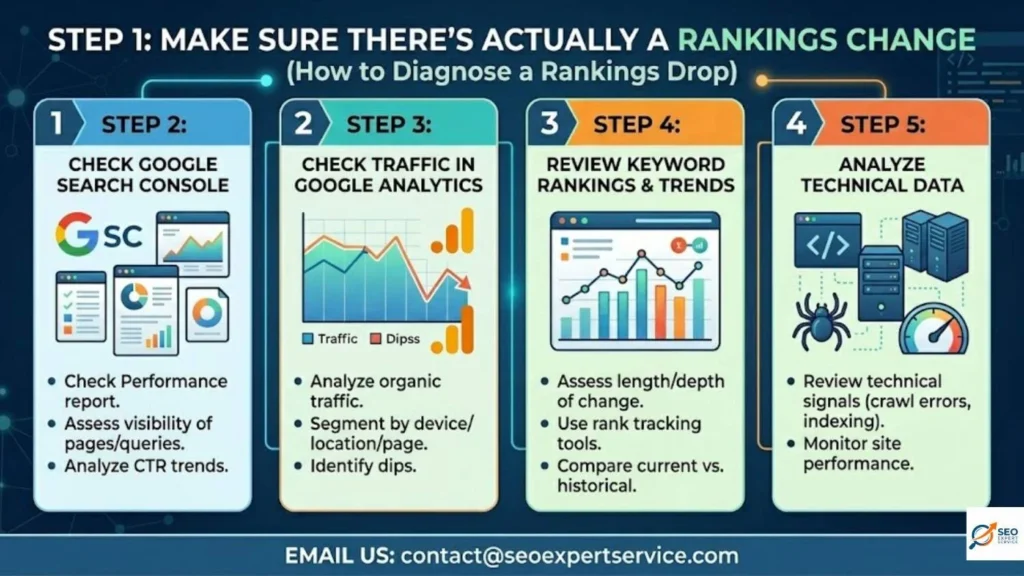
The worst way to respond to a ranking drop is to start making random changes. SEO recovery begins with diagnosis. Before you go down this rabbit hole of rankings changes, make sure there was actually a rankings change.
Sometimes, an apparent SEO rankings drop is just a glitch in a ranking tracker tool or a temporary change that will naturally correct itself relatively quickly. Here are some steps you can take to verify that your rankings dropped:
Step 1: Check Google Search Console
Google Search Console is usually the first place to look when investigating a ranking drop. The Performance report shows changes in average position, changes in click-through rate, changes in search traffic, and which queries and pages lost visibility.
Step 2: Check Traffic in Google Analytics
Try checking your ranking’s data, as well as your organic traffic data, in several tools, including Google Search Console and Google Analytics. Look for changes in organic traffic trends, device segments, landing pages, and geographic traffic sources.
Step 3: Review Keyword Rankings and Visibility Trends
Assess the length and depth of the change. Check how long your rankings have been lower than usual to ensure it’s an actual drop and not just a temporary change. Compare the change to your typical week-to-week and daily fluctuations.
Step 4: Analyze Technical Data
If rankings dropped suddenly across many pages, it’s often worth reviewing technical signals such as server logs, crawl errors, indexing issues, and page speed performance.
Figure Out What Went Wrong: What are the Common Causes of Declining Rankings?
| Cause of Ranking Drop | How to Diagnose It | Primary Solution |
| Manual Action (Penalty) | Google Search Console (Manual Actions report) | Fix the exact violation and submit a Reconsideration Request. |
| Core Algorithm Update | Correlate drop dates with confirmed Google updates | Improve E-E-A-T signals, remove thin content, enhance overall quality. |
| Technical SEO Issues | PageSpeed Insights, Crawl Error logs | Fix ‘noindex’ tags, improve load speed, ensure mobile responsiveness. |
| Lost Backlinks | SEO Tools (Ahrefs, SEMrush, Moz) | Conduct a link audit, reach out to lost referring domains, build new links. |
| Competitor Outranking | SERP analysis for targeted keywords | Upgrade content depth, add better multimedia, match current search intent. |
Many factors can contribute to dropping rankings, and addressing these issues head-on can reposition your site where it belongs at the top of SERPs. Here are the common reasons for SEO rankings decrease:
1. Did Google update their algorithm? (Core Updates & Spam Updates)
Most of the time, ranking drops are caused by Google’s regular algorithm updates, not manual actions. Google is always refining its search system to provide better results. It makes hundreds of changes each year.
Sometimes, a broad core update can shake up the rankings significantly. What worked yesterday might not work today. This is not a penalty; it is the algorithm re-evaluating your site based on new quality signals.
Google also runs “Spam updates.” Spam updates focus on identifying and reducing manipulative SEO practices. These updates typically target signals like low-quality backlinks, artificial link schemes, automatically generated content, and thin or spammy pages.
2. There Are Manual Actions Against Your Site (Google Penalties)
If your Google rankings dropped overnight, check whether you received a manual penalty. A Google penalty, or manual action, is when a human reviewer at Google decides your site violates their guidelines.
These are serious, but they are also less common than other causes. The good news is that Google tells you directly if you have one. Common violations include keyword stuffing, cloaking (showing different content to users and search engines), and indulging in paid link schemes.
3. Your Technical SEO is Missing Crucial Pieces
Technical SEO is another pillar of a robust SEO strategy. Overlooking this can result in your site not being crawled or indexed adequately by search engines. Sometimes the problem is purely technical.
- Slow Loading Speed: A slow website creates a poor user experience and is a known ranking factor.
- Mobile Unfriendliness: With Google’s mobile-first indexing, a site that isn’t mobile-friendly can significantly lose rankings.
- Accidental ‘noindex’ Tags: A developer might accidentally leave a ‘noindex’ tag on a page or even the entire site after maintenance.
- Web Host Issues: Your pages can take an eternity to load, no thanks to your web hosting company. If the problem lies with your web hosting company, find a better one.
If you aren’t sure where to start, learning how to perform a technical SEO audit can highlight the exact page speed or mobile errors holding you back.
4. The Content on Your Page is Outdated
Search engines prioritize content that is current and relevant. If your website content hasn’t been updated in a while, it may start to lose its value in the eyes of search engines. Irrelevant information, outdated facts, figures, or data can diminish the credibility of your content.
5. You’ve Lost Backlinks (Or Important Votes)
Backlinks are like votes of confidence from other websites. Losing them can weaken your site’s authority and trustworthiness.
There are several reasons why something like this would happen:
- The website with your backlinks could have gone offline.
- Webmasters can remove links, either due to site restructuring or policy changes.
- Links from outdated or low-authority sites can lose their value.
6. Your Competitor Outranked You (The Keywords Just Got More Competitive)
SEO is a constant battle for the top spot. A key reason for dropping rankings is increased keyword competition.
Competitors may be constantly updating their content, making it more relevant and valuable. They may have garnered high-quality backlinks that bolster their authority. Getting to the top of a search page is one thing, but staying there is another.
7. You Redesigned Your Website or Made Accidental Changes
Did you make any changes recently?. If you redesigned your website immediately before experiencing an SEO drop, it’s likely that the launch had a negative impact on your search rankings.
You may have forgotten to install redirects, for one thing. Your Google rankings may drop dramatically if you don’t have proper 301 redirects in place. 301 redirects inform Google of your page’s new address and tell it to index the new page rather than the old one.
8. Changes in Search Intent or SERP Layout
Sometimes rankings drop because Google’s interpretation of search intent changes. For example, a keyword that once returned informational blog posts may begin showing product pages or videos instead. When that happens, your page may lose relevance for the query even if the content hasn’t changed.
9. Google’s User Feedback Says You Should Rank Differently
Google is using machine learning to determine rankings. That means they’re at least in part measuring the value of your pages based on their click-through rate from SERPs and how long visitors stay on your page before returning to Google. Did you recently add a popup that is increasing bounce rate?. Is the page taking longer to load?. This user behavior tells Google that users didn’t find the page useful and may lead to lower rankings.
10. The Mysterious Google Flux
At the end of the day, no matter how well you run your website, you are the mercy of almighty Google. As Google tampers with its algorithm, unpredictable changes occur on a regular basis that upset the position of websites. This phenomenon is called “Google flux”.
9 Steps to Recover SEO Rankings (Your Action Plan)
The approach should be systematic and focus on long-term quality, not short-term tricks. Here are the step-by-step instructions on how to recover SEO rankings:
| Phase | Recovery Steps | Focus Area | Expected Timeframe |
| Phase 1: Diagnose | Check GSC, Analytics, and Trackers | Identifying the exact root cause | 1-3 Days |
| Phase 2: Fix Errors | Address Manual Actions & Tech Bugs | Crawlability, Indexing, Speed | 1-2 Weeks |
| Phase 3: Upgrade | Improve Content & E-E-A-T | Relevance, User Experience, Depth | 2-4 Weeks |
| Phase 4: Build | Audit and Rebuild Backlinks | Domain Authority, Trust Signals | 1-3 Months |
Step 1: Acknowledge the Drop & Take a Deep Breath
Acknowledging the drop in rankings can be a bitter pill to swallow, but it’s a crucial starting point. The worst thing you can do right now is make rash changes. Hasty decisions made in a panic often make things worse. Instead of frantically changing title tags, overhauling your site design, or deleting pages, your first step is to be a detective.
Step 2: Identify Violations & Address a Manual Penalty
If you were unlucky enough to get a manual action, your path is clear. Google has told you what the problem is. First, you need to fix the specific issue Google identified. Once you have made a genuine effort to fix the problem, you must submit a “Reconsideration Request” through Google Search Console. Be honest, be thorough, and document your cleanup efforts.
Step 3: Check for Algorithm Updates & Recover From Them
Algorithm updates are an inevitable part of the SEO landscape. There is no reconsideration request for an algorithm update. Your only option is to improve your website’s overall quality and demonstrate to Google that you deserve to rank again.
Step 4: Solve Technical Issues & Fix Indexation Blockages
Technical SEO is equally crucial. Even the best content can struggle to rank if your site has technical issues. Ensure that your robots.txt file is not blocking important pages from being crawled and create and submit an XML sitemap to ensure that search engines can easily find all pages on your site.
Step 5: Re-evaluate Your Content Quality (Improve, Consolidate, Remove)
You need to honestly assess your pages that lost ranking. You need to honestly assess your pages that lost ranking, especially because understanding why having duplicate content is an issue for SEO can save you from algorithmic penalties.
- Improve: Add more detail, new data, expert quotes, and helpful images or videos to make the content more useful.
- Consolidate: Combine multiple weak pages about the same topic into one strong page.
- Remove: Delete content that is outdated, irrelevant, or has no traffic and no links.
Step 6: Strengthen Your E-E-A-T Signals
Experience, Expertise, Authoritativeness, and Trustworthiness are concepts Google uses to measure page quality. Simple ways to build trust include adding clear author bios with credentials and links to their social profiles. You can also showcase awards, certifications, or positive customer testimonials.
Step 7: Conduct a Website Audit & Fix On-Page SEO
An SEO website audit emerges as a comprehensive examination that provides an in-depth analysis of a website’s visibility in search engines.
Having a step-by-step SEO audit checklist ensures that you don’t miss any critical on-page elements during your recovery process.
Missing or poorly written Meta Tags should be fixed. Title tags and meta descriptions should be compelling and keyword-optimized. Ensure key phrases are seamlessly integrated within your content, headers, and subheaders.
Step 8: Audit Your Backlinks & Rebuild Lost Links
Conducting a backlink audit is a crucial step in recovering SEO rankings. It’s essential to identify and disavow any toxic backlinks that might be harming your site’s reputation. Then, revert to effective link-building strategies to regain lost ground. Guest blogging is an excellent way to earn valuable backlinks. Sourcing your placements from a high-quality backlink list will protect your site from future Google Spam updates.
Step 9: Leverage Social Media & Monitor Your Rankings
Social media can indirectly impact your SEO by driving traffic, increasing engagement, and elevating brand visibility. Use platforms like Facebook, X, LinkedIn, and Instagram to share your content regularly. Once you’ve taken action to correct the issue, keep an eye on your rankings to see if they improve over the next several weeks.
Don’t Let Your Website Fade Away!
Learning how to recover SEO rankings is hard work. Let Seo Expert Service do the heavy lifting for you email us: contact@seoexpertservice.com
How to Future-Proof Against Ranking Drops

The best defense against ranking drops isn’t reacting quickly. It’s building an SEO strategy resilient enough to weather them. Because ranking fluctuations will always happen. Google evolves. Competitors improve. Search behavior changes.
Here is how you protect yourself:
Maintain Strong Content Quality
Google consistently rewards sites that demonstrate strong E-E-A-T signals. That means publishing content that reflects real expertise, clear authority, trustworthy information, and strong user value. Pages that genuinely help users tend to perform better over the long term.
Strengthen Your Site Authority
Authority remains a major ranking factor. Sites with strong authority signals – such as high-quality backlinks, strong brand recognition, and consistent content publishing – tend to recover from ranking fluctuations more easily. Investing in authority building helps protect long-term SEO performance.
Diversify Traffic Sources
Perhaps the most important lesson many businesses learn after a rankings drop is this: Never rely entirely on one traffic source. Search traffic is powerful, but it shouldn’t be the only way users find your business. Strong digital strategies also include email marketing, social media traffic, direct brand searches, and referral traffic. Diversifying traffic sources makes businesses far more resilient to algorithm changes.
Conclusion: Don’t Panic, Act Strategically
Ranking drops feel dramatic in the moment. But they’re also a normal part of SEO. Search engines constantly refine how they evaluate websites. Competitors improve their content. New pages enter the search results.
The important thing is not the drop itself. It’s how you respond. Carefully diagnosing the issue, understanding what changed, and implementing the right recovery strategy often restore lost rankings over time.
Because SEO success isn’t about never losing rankings. It’s about building a site strong enough to earn them back. Recovery will take time and consistent effort, but the outcome is a stronger, more resilient website.
Are you ready to stop losing money and start getting your website visitors back today?
Let the seasoned team at Seo Expert Service build a bulletproof recovery plan for you right now email us: contact@seoexpertservice.com
Which of these recovery steps do you think you need to tackle first for your website?
Also Read: How Often Should You Conduct an SEO Audit?
People Also Ask (FAQs)
How long does it take to learn how to recover SEO rankings?
Recovery will take time and consistent effort, but the outcome is a stronger, more resilient website. It could take a few weeks or a few months, depending on if you are dealing with a technical glitch or building new, high-quality inbound links. If you are frustrated with the timeline, understanding exactly why SEO takes so long can help set realistic expectations for your recovery.
Can Google algorithms really drop my site that fast?
Yes! Google rolls out a new algorithm update at least every day, most silently. Sometimes, a broad core update can shake up the rankings significantly. What worked yesterday might not work today.
What if I get a Google manual penalty?
If you received a manual penalty, go to the Manual Actions report or the message center in Google Search Console. The Manual Actions report will describe the reason for the penalty, the pages affected, and steps for how to fix the issue. Once you’ve fixed the issues, submit a reconsideration request.
Should I buy links to recover?
No! Engaging in link schemes or buying backlinks can flag your site as manipulative. Focus your long-term efforts on earning high-quality links from respected sites in your industry, as these are a powerful vote of confidence.
Can my competitors steal my spot?
Yes. Getting to the top of a search page is one thing, but staying there is another. Getting outranked by a competitor is an everyday fact of SEO life.