
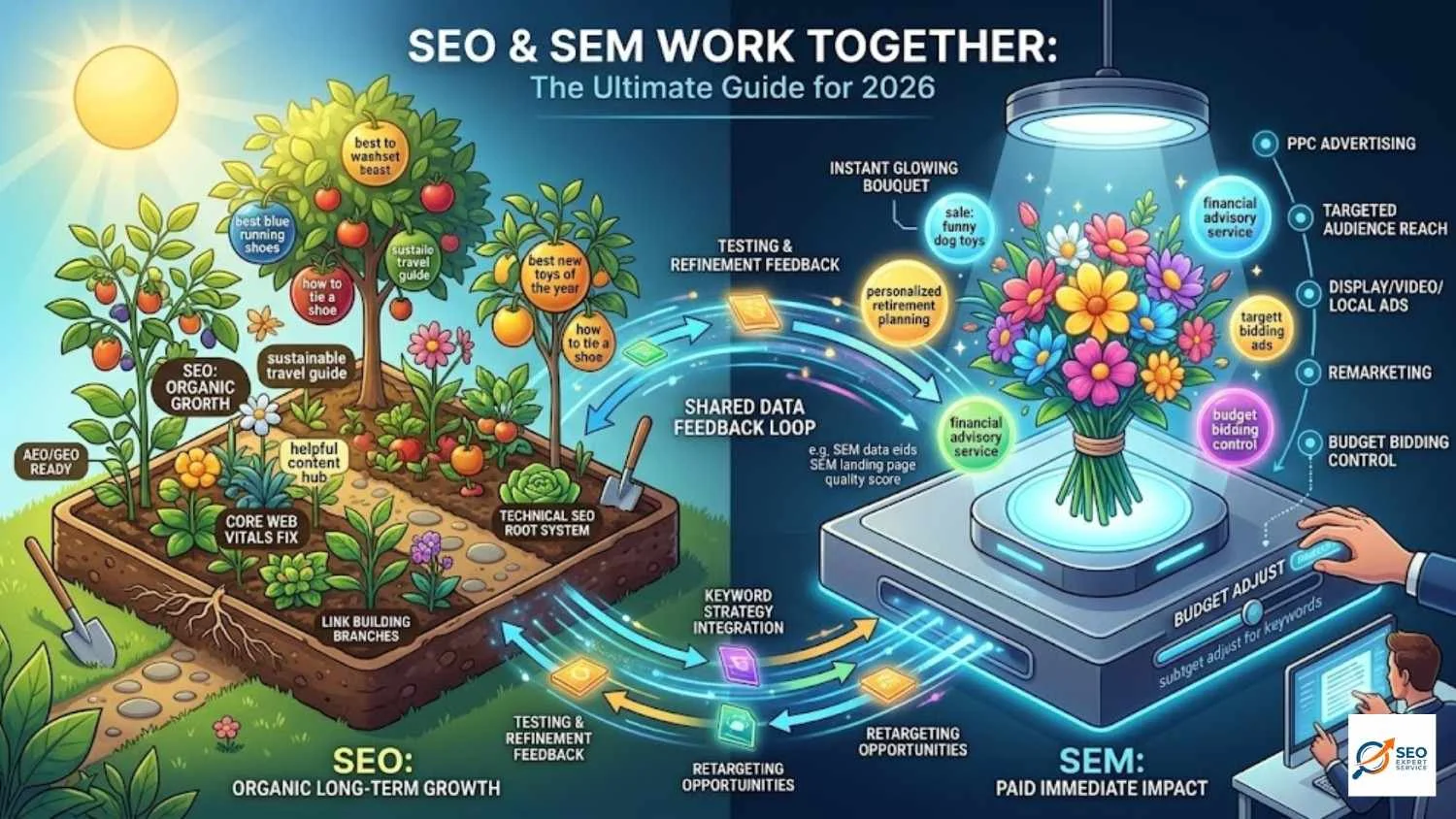
SEO and SEM work together by combining long-term organic traffic with instant paid visibility.
SEO helps your website rank naturally on Google over time.
SEM helps your business appear immediately through paid ads like Google Ads.
When both strategies work together, they help you:
- Get more website visitors
- Increase brand trust
- Generate more qualified leads
- Improve conversion rates
- Lower your overall marketing cost
- Dominate Google search results
Instead of choosing SEO or SEM, smart businesses use both to grow faster.
Table of Contents
Why Should You Read This Guide?
Many business owners ask questions like:
- Should I invest in SEO or Google Ads?
- Is SEO better than SEM?
- Can SEO improve PPC performance?
- Does Google Ads help SEO?
- Which strategy gives better ROI?
The answer isn’t choosing one over the other.
The real success comes when SEO and SEM work together.
In this complete guide, you’ll learn:
- What SEO is
- What SEM is
- The biggest differences
- How they support each other
- When to use each strategy
- Common mistakes to avoid
- 2026 Google best practices
- How to build a winning search marketing strategy
By the end, you’ll know exactly how to grow your business using both organic and paid search.
What is SEO?
SEO (Search Engine Optimization) is the process of improving your website so it appears higher in Google’s free search results.
You don’t pay Google when someone clicks your SEO result.
Instead, Google ranks your pages because they are helpful, trustworthy, and relevant.
Think of SEO like planting a tree.
It takes time to grow.
But once it grows, it keeps giving you results for years.
SEO Helps You:
- Increase organic traffic
- Rank for valuable keywords
- Build customer trust
- Generate long-term leads
- Reduce advertising costs
- Improve online visibility
Example
Imagine someone searches:
“Best physiotherapy clinic near me”
If your website is well optimized, Google may show your business on the first page.
When users click your website, you don’t pay anything for that click.
That’s the power of SEO.
How Does SEO Work?
Google uses hundreds of ranking signals to decide which websites deserve the top positions.
Some of the biggest factors include:
1. High-Quality Content
Helpful content answers users’ questions better than competitors.
2. Keyword Optimization
Using the right keywords naturally helps Google understand your content.
3. Technical SEO
Google prefers websites that are:
- Fast
- Secure
- Mobile-friendly
- Easy to crawl
4. User Experience (UX)
Visitors should easily find what they need.
Simple navigation, readable text, and fast pages improve rankings.
5. Backlinks
When trusted websites link to yours, Google sees your website as more trustworthy.
6. E-E-A-T
Google wants content created by people with:
- Experience
- Expertise
- Authoritativeness
- Trustworthiness
In 2026, E-E-A-T is more important than ever because AI-generated content is everywhere. Websites that demonstrate real experience and credibility have a stronger chance of earning visibility.
The Four Types of SEO
Every successful SEO strategy includes four important areas.
1. On-Page SEO
This focuses on everything inside your website.
Examples:
- Page titles
- Headings
- Keywords
- Images
- Internal links
- Meta descriptions
2. Technical SEO
Technical SEO helps search engines crawl and index your website.
It includes:
- Website speed
- XML sitemap
- Core Web Vitals
- Mobile optimization
- HTTPS security
- Structured data (Schema)
3. Off-Page SEO
Off-page SEO builds your website’s authority.
Examples:
- High-quality backlinks
- Digital PR
- Brand mentions
- Guest posting
4. Local SEO
Local SEO helps nearby customers find your business.
It includes:
- Google Business Profile
- Local citations
- Customer reviews
- Maps optimization
- Local keywords
Businesses that serve specific cities or regions often see significant growth by investing in Local SEO alongside their broader optimization efforts.
What is SEM?
SEM (Search Engine Marketing) is the process of getting traffic through paid search advertising.
Today, SEM mainly refers to Google Ads and Microsoft Ads (Bing Ads).
Instead of waiting months to rank, your ads can appear on Google almost immediately.
You pay only when someone clicks your advertisement.
This model is called Pay-Per-Click (PPC).
Example
Someone searches:
“Sports injury physiotherapy Delhi”
Your Google Ad appears at the top.
The customer clicks.
You pay only for that click.
If the visitor books an appointment, the investment can produce an immediate return.
How Does SEM Work?
SEM follows a simple process.
Step 1
Choose keywords people search.
Example:
- Physiotherapy clinic
- Sports injury treatment
- Back pain specialist
Step 2
Create Google Ads.
Include:
- Headlines
- Descriptions
- Call-to-action
- Landing page
Step 3
Set Your Budget
Choose:
- Daily budget
- Maximum CPC
- Campaign goals
Step 4
Launch Ads
Google begins showing ads to people searching for your keywords.
Step 5
Track Results
Monitor:
- Clicks
- Conversions
- Cost per Lead
- ROI
Then improve campaigns continuously for better performance.
Modern SEM also includes audience targeting, negative keywords, conversion tracking, location targeting, and ongoing bid optimization to maximize results.
Common Types of SEM Campaigns
Businesses can use different paid campaigns depending on their goals.
• Search Ads
Appear at the top of Google search results.
Best for lead generation.
• Display Ads
Banner advertisements shown across millions of websites.
Great for brand awareness.
• Shopping Ads
Ideal for eCommerce businesses selling products.
• Video Ads
Advertise on YouTube and video platforms.
Perfect for increasing visibility.
• Local Service Ads
Help local businesses generate calls and appointments.
• Remarketing Ads
Show ads again to visitors who already visited your website.
These campaigns often produce higher conversion rates because users already know your brand.
SEO vs SEM: What’s the Difference?
| Feature | SEO | SEM |
| Cost Per Click | Free | Paid |
| Results | Long-term | Immediate |
| Traffic Source | Organic | Paid |
| Visibility | Earned | Purchased |
| Trust Level | Very High | High |
| Long-Term ROI | Excellent | Depends on ad spend |
| Stops When Budget Ends? | No | Yes |
| Best For | Sustainable growth | Fast leads |
Ready to Grow with SEO and SEM?
At Seo Expert Service, we help businesses combine SEO and SEM.
One powerful strategy that delivers both immediate results and long-term growth email us : contact@seoexpertservice.com
How SEO and SEM Work Together: The Secret Behind High-Growth Businesses
Many people think they have to choose between SEO and SEM.
That’s not true.
The fastest-growing businesses use both.
SEO brings steady, long-term traffic.
SEM delivers quick visibility and instant leads.
When these two strategies work together, they create a powerful search marketing system that attracts customers at every stage of their buying journey.
Think of it like riding a bicycle.
SEO is one wheel.
SEM is the other.
If one wheel is missing, moving forward becomes much harder.
Why Combining SEO and SEM Is Better Than Using Only One
Using only SEO means waiting several months before seeing significant results.
Using only SEM means traffic usually stops when your advertising budget ends.
But combining both gives you the best of both worlds.
Benefits of Using SEO and SEM Together
- More visibility on Google
- More qualified website visitors
- Better brand awareness
- Higher click-through rates (CTR)
- Lower customer acquisition costs over time
- More leads and sales
- Better return on investment (ROI)
- Stronger trust with potential customers
Many successful brands appear in both the paid ads section and the organic search results, giving users multiple opportunities to click on their business. This dual presence improves visibility and credibility.
How SEO and SEM Work Together
SEO and SEM aren’t competitors.
They support each other in many ways.
Let’s look at the biggest ones.
1. SEM Finds Winning Keywords Faster
One of the biggest advantages of SEM is speed.
Within a few days, Google Ads tells you:
- Which keywords get clicks
- Which keywords generate leads
- Which keywords waste money
Instead of guessing what people search, you already have real data.
You can then use those successful keywords inside your SEO strategy.
Example
Suppose you run a physiotherapy clinic.
Your Google Ads campaign shows that:
“Sports physiotherapist near me”
gets far more bookings than
“Sports injury clinic.”
Now you know which keyword deserves its own SEO page.
Instead of guessing…
You’re making decisions based on real customer behavior.
This is exactly how smart businesses grow faster.
2. SEO Improves SEM Performance
Many business owners don’t know this.
Good SEO can actually improve your Google Ads performance.
Why?
Because Google looks at your landing page quality.
If your page is:
- Fast
- Mobile friendly
- Helpful
- Easy to use
Google rewards you with a better Quality Score.
A higher Quality Score can mean:
- Lower Cost Per Click (CPC)
- Better Ad Rank
- Higher Click-Through Rate
- More conversions for the same budget
A technically optimized website and useful content don’t just help organic rankings they also support stronger paid advertising performance by improving landing page experience and relevance.
3. Dominate Google’s Search Results
Imagine someone searches:
“Best SEO Company in Delhi.”
Now imagine your business appears:
- As the first Google Ad
AND
- As the first organic result
Now your brand owns most of the screen.
This creates:
- More trust
- More clicks
- Better brand recall
- Higher conversions
People naturally trust businesses they see multiple times.
This strategy is often called SERP Domination.
It is one of the biggest benefits of combining SEO and SEM.
4. SEO Builds Trust While SEM Creates Immediate Action
People don’t always buy immediately.
Some need time.
Others are ready today.
SEM helps capture users who are ready to purchase now.
SEO helps educate people who are still researching.
Together, they support customers throughout the buying journey.
For example:
Awareness Stage
Customer searches:
“What causes knee pain?”
SEO blog answers the question.
Consideration Stage
Customer searches:
“Best physiotherapy clinic”
Your organic page appears.
Decision Stage
Customer searches:
“Book physiotherapy appointment today”
Your Google Ad appears.
Now you’re visible at every stage.
Shared Keyword Strategy
One of the smartest ways to combine SEO and SEM is by using one keyword strategy.
Instead of having separate keyword lists…
Create one master keyword list.
Then decide:
Use SEO For
- Informational keywords
- Long-tail keywords
- Educational searches
- Evergreen topics
Examples:
- What is technical SEO?
- SEO checklist
- Benefits of physiotherapy
Use SEM For
- High buying intent keywords
- Commercial keywords
- Emergency services
- Local searches
Examples:
- Hire SEO Expert
- SEO Company Near Me
- Physiotherapy Clinic Delhi
- Emergency Back Pain Treatment
Sharing keyword data between SEO and SEM teams helps businesses prioritize high-performing search terms and build stronger campaigns across both channels.
How SEM Data Improves SEO Content
Google Ads gives valuable information about your audience.
You can discover:
- Popular search terms
- Questions users ask
- Best-performing headlines
- High-converting landing pages
Now use this information to improve:
- Blog posts
- Service pages
- FAQs
- Meta titles
- Meta descriptions
Instead of writing content based on assumptions…
You’re creating content based on proven search behavior.
How SEO Data Improves SEM Campaigns
The relationship works both ways.
Your SEO tools show:
- Pages with highest traffic
- Best-converting content
- Top-performing keywords
- High-engagement topics
These insights help create better:
- Google Ads
- Headlines
- Descriptions
- Landing pages
Businesses often use strong-performing organic content to inspire more effective paid search campaigns and improve ad relevance.
Landing Pages: Where SEO and SEM Meet
Both SEO and SEM rely on great landing pages.
A good landing page should:
- Match search intent
- Load quickly
- Work on mobile devices
- Include clear headings
- Provide useful information
- Have a strong call-to-action
- Build trust with reviews or testimonials
If someone clicks your ad and lands on a slow or confusing page, they’re likely to leave without converting.
Optimized landing pages improve both organic rankings and paid advertising results.
Content Marketing Powers Both SEO and SEM
Content is valuable for both strategies.
A single piece of content can serve multiple purposes.
For example:
A blog titled:
“10 Exercises for Lower Back Pain”
can:
- Rank in Google through SEO
- Be promoted with Google Ads
- Be shared on social media
- Build trust with potential customers
- Generate email subscribers
This approach increases the value of every piece of content you create.
Website Experience Matters for Both
Whether visitors arrive through SEO or SEM…
They expect a great experience.
Your website should be:
- Fast
- Secure (HTTPS)
- Mobile responsive
- Easy to navigate
- Free from broken links
- Accessible to all users
A positive user experience increases engagement, reduces bounce rates, and supports better performance across both organic and paid search efforts.
Measure Everything
SEO and SEM become much more effective when you track performance.
Key metrics include:
SEO Metrics
- Organic traffic
- Keyword rankings
- Click-through rate (CTR)
- Bounce rate
- Average session duration
- Organic conversions
SEM Metrics
- Cost Per Click (CPC)
- Cost Per Lead (CPL)
- Conversion Rate
- Quality Score
- Return on Ad Spend (ROAS)
- Impression Share
Looking at these metrics together helps you make smarter marketing decisions instead of treating SEO and SEM as separate channels.
Quick Checklist: Are Your SEO and SEM Working Together?
- Shared keyword research
- Optimized landing pages
- Mobile-friendly website
- Fast page speed
- Conversion tracking enabled
- High-quality content
- Strong calls-to-action
- Regular performance reviews
If you answered “No” to any of these, there’s an opportunity to improve your overall digital marketing results.
Grow Faster with a Unified SEO & SEM Strategy
At Seo Expert Service, we don’t treat SEO and SEM as separate services—we build integrated campaigns that generate immediate leads while creating long-term organic growth.
Why Choose Us?
- Custom SEO strategies
- ROI-focused Google Ads campaigns
- Technical SEO improvements
- Landing page optimization
- Keyword research backed by real data
- Transparent monthly reporting
Get Started Today Email Us : contact@seoexpertservice.com
2026 SEO & SEM Best Practices: Future-Proof Your Search Marketing Strategy
Google has changed a lot over the last few years.
Today, ranking on Google is no longer just about adding keywords to a page.
The search engine now focuses on:
- Helping people find answers faster
- Understanding search intent
- Showing AI-generated summaries
- Highlighting trustworthy brands
- Rewarding websites with real experience
If you want to succeed in 2026, your SEO and SEM strategies must work together while adapting to Google’s latest updates.
Let’s explore the most important trends.
Google’s 2026 Search Landscape
Today’s Google search results include much more than ten blue links.
Users now see:
- AI Overviews
- Featured Snippets
- People Also Ask
- Local Map Pack
- Shopping Results
- Google Ads
- Videos
- Images
- Knowledge Panels
Your goal isn’t simply to rank.
Your goal is to appear in as many search features as possible.
The more places your brand appears, the more trust and traffic you earn.
What is AEO (Answer Engine Optimization)?
AEO (Answer Engine Optimization) means creating content that gives users a direct, clear answer to their questions.
Instead of only ranking webpages, search engines now try to answer questions immediately.
Examples include:
- Google AI Overviews
- Featured Snippets
- Voice Search
- ChatGPT
- Gemini
- Microsoft Copilot
- Perplexity AI
If your content answers questions clearly, these platforms are more likely to use it.
How to Optimize for AEO
Write simple answers
Answer the question in the first few sentences.
Example:
Question
How do SEO and SEM work together?
Answer
SEO builds long-term organic traffic, while SEM delivers instant visibility through paid advertising. Together they increase traffic, leads, and conversions.
Use Question-Based Headings
Instead of writing
Benefits
Write
What Are the Benefits of Using SEO and SEM Together?
This matches how people search.
Add FAQ Sections
Google loves FAQ-style content.
Examples:
- What is SEO?
- What is SEM?
- Which is better?
- Does Google Ads improve SEO?
Each answer should be short, simple, and accurate.
Use Lists and Tables
Search engines understand structured information more easily.
Use:
- Bullet points
- Numbered lists
- Comparison tables
- Checklists
These formats also improve readability for users.
What is GEO (Generative Engine Optimization)?
GEO (Generative Engine Optimization) is the practice of optimizing your content so AI search engines can understand, trust, and recommend it.
Unlike traditional SEO, GEO focuses on becoming a trusted source for AI-generated answers.
Instead of asking:
“Can I rank #1?”
Ask:
“Will AI trust my content enough to recommend it?”
That’s the future of search.
How to Optimize for GEO
Write Original Content
Avoid copying competitors.
Share:
- Real examples
- Personal experience
- Expert advice
- Case studies
- Original research
Unique content is more valuable than rewritten information.
Demonstrate Experience
Google and AI systems trust content created by people with real-world expertise.
Include:
- Industry experience
- Client success stories
- Practical examples
- Helpful insights
This strengthens your credibility.
Add Statistics
Whenever possible, support your points with:
- Industry reports
- Survey findings
- Performance data
Statistics increase trust and authority.
Use Clear Structure
AI understands organized content better.
Include:
- H2 headings
- H3 headings
- Tables
- Lists
- Short paragraphs
This improves both human readability and machine understanding.
Why E-E-A-T Matters More Than Ever
Google evaluates whether your content demonstrates:
- Experience
- Expertise
- Authoritativeness
- Trustworthiness
This framework helps Google decide which pages deserve visibility.
Experience
Show you’ve actually done the work.
Instead of saying:
“We know SEO.”
Say:
“We’ve helped businesses increase organic traffic through strategic SEO and paid search campaigns.”
Real-world experience builds confidence.
Expertise
Write accurate, detailed information.
Avoid vague advice.
Explain concepts clearly and back them with practical examples.
Authoritativeness
Become known as a reliable source.
You can build authority by:
- Publishing helpful articles
- Earning backlinks
- Collecting positive reviews
- Being mentioned on reputable websites
Trustworthiness
Build trust with visitors by including:
- Contact details
- Privacy policy
- HTTPS security
- Genuine testimonials
- Transparent business information
Trust encourages both users and search engines to engage with your content.
Voice Search Optimization
Millions of searches now happen through voice assistants.
People speak differently than they type.
Instead of typing:
SEO agency Delhi
They ask:
“Which SEO agency near me offers affordable SEO services?”
Your content should sound conversational.
Voice Search Tips
- Write naturally.
- Answer complete questions.
- Include local keywords.
- Use FAQ sections.
- Keep answers concise.
This increases your chances of appearing in voice search results.
AI Overviews: The New Opportunity
Google’s AI Overviews summarize answers directly on the search results page.
If your content is clear and trustworthy, it may be referenced in these summaries.
To improve your chances:
- Answer questions early.
- Use descriptive headings.
- Add supporting examples.
- Keep information accurate and up to date.
- Demonstrate expertise.
Winning visibility in AI Overviews can drive brand awareness even when users don’t click immediately.
Featured Snippets
Featured Snippets appear above the regular organic listings.
These highlighted answers often receive strong visibility.
Ways to Win Featured Snippets
Use Direct Definitions
Example:
What is SEM?
SEM is a paid search marketing strategy that places advertisements on search engine results pages to generate immediate website traffic.
Create Step-by-Step Guides
Google often selects numbered instructions.
Example:
- Research keywords
- Create content
- Optimize pages
- Track results
Add Comparison Tables
Example:
| SEO | SEM |
| Organic Traffic | Paid Traffic |
| Long-Term | Immediate |
| Builds Authority | Builds Instant Visibility |
Tables help users compare information quickly.
Zero-Click Searches
Sometimes users get their answers directly on the search results page without clicking a website.
This is called a Zero-Click Search.
Although clicks may decrease, appearing in these results still strengthens brand recognition.
To increase your visibility:
- Provide concise answers.
- Use structured headings.
- Include FAQs.
- Add schema markup.
- Keep content well organized.
Local SEO + SEM: A Powerful Combination
Local businesses benefit greatly from combining organic optimization with paid advertising.
For example:
A dental clinic in Gurgaon can:
- Rank organically for “best dentist in Gurgaon.”
- Run Google Ads for “emergency dentist near me.”
- Optimize its Google Business Profile.
- Collect positive reviews.
- Create location-specific service pages.
This approach helps attract customers who are ready to take action.
Content Marketing Supports Both SEO and SEM
Every great piece of content can work across multiple channels.
One blog article can:
- Rank organically.
- Support Google Ads.
- Generate social media posts.
- Build email campaigns.
- Increase backlinks.
- Answer customer questions.
Creating valuable content once and promoting it across channels improves your overall marketing efficiency.
Essential SEO & SEM Tools for 2026
Using the right tools helps you make smarter decisions.
SEO Tools
- Google Search Console
- Google Analytics 4
- Ahrefs
- SEMrush
- Screaming Frog
- PageSpeed Insights
SEM Tools
- Google Ads
- Microsoft Ads
- Google Keyword Planner
- Google Tag Manager
- Looker Studio
- Google Merchant Center (for eCommerce)
These tools help track performance, identify opportunities, and optimize campaigns.
Common Mistakes to Avoid
Many businesses struggle because they make avoidable mistakes.
Here are some of the most common:
- Treating SEO and SEM as separate strategies
- Ignoring mobile optimization
- Targeting the wrong keywords
- Creating thin or duplicate content
- Sending paid traffic to weak landing pages
- Not tracking conversions
- Focusing only on rankings instead of leads and revenue
- Forgetting to update older content
Avoiding these issues helps improve both user experience and search performance.
Quick Checklist for 2026 Success
- Focus on user intent
- Build helpful, original content
- Demonstrate E-E-A-T
- Optimize for AI Overviews
- Create FAQ sections
- Improve page speed
- Track conversions
- Share keyword data between SEO and SEM
- Optimize landing pages
- Keep content updated regularly
Ready to Future-Proof Your SEO & SEM Strategy?
Google’s search landscape will continue to evolve, but one principle remains the same: businesses that provide helpful content and deliver a great user experience are best positioned for long-term success.
At Seo Expert Service, we help businesses combine SEO, SEM, AEO, and GEO into one integrated strategy designed for today’s search engines and tomorrow’s AI-powered search experiences.
Our Services Include
- Advanced SEO
- Google Ads Management
- Technical SEO Audits
- Local SEO
- Content Marketing
- Conversion Rate Optimization (CRO)
- AI Search Optimization (AEO & GEO)
Book Your Free Strategy Session Email Us : contact@seoexpertservice.com
Real-World SEO + SEM Strategy: Costs, ROI, Case Studies & Expert Tips
Most businesses ask the same question before investing in digital marketing:
“Should I spend my budget on SEO or Google Ads?”
The better question is:
“How can I use SEO and SEM together to get the highest return on investment?”
The answer depends on your goals, competition, timeline, and budget.
Let’s break it down.
SEO vs SEM: Which One Delivers Better ROI?
There isn’t a single winner.
Both strategies provide value—but in different ways.
| Factor | SEO | SEM |
| Initial Results | 3–6 Months | 1–7 Days |
| Long-Term ROI | ⭐⭐⭐⭐⭐ | ⭐⭐⭐ |
| Brand Trust | Very High | High |
| Cost Per Click | Free | Paid |
| Scalability | Excellent | Depends on Budget |
| Best For | Sustainable Growth | Fast Leads |
| Traffic Stops if Budget Ends? | No | Yes |
Best Strategy: Use SEM to generate immediate leads while SEO builds a long-term source of free, organic traffic. Over time, this balanced approach can reduce reliance on paid advertising and improve overall ROI.
Understanding the Customer Journey
Customers don’t always buy the first time they visit your website.
A complete strategy supports every stage of the buying process.
Awareness Stage
Customer searches:
- What is SEO?
- How does Google Ads work?
Best Channel: SEO
Consideration Stage
Customer searches:
- Best SEO agency
- SEO pricing
- Google Ads management
Best Channel: SEO + SEM
Decision Stage
Customer searches:
- Hire SEO expert
- SEO company near me
Best Channel: SEM + Local SEO
When SEO and SEM work together, your business stays visible from the first search to the final purchase.
Budget Allocation: How Much Should You Spend?
Every business has a different budget.
Here’s a simple framework.
Small Businesses
Monthly Budget: ₹30,000–₹75,000
Suggested Split:
- SEO – 70%
- SEM – 30%
Focus:
- Building organic visibility
- Local SEO
- Brand awareness
Growing Businesses
Monthly Budget: ₹75,000–₹2,00,000
Suggested Split:
- SEO – 60%
- SEM – 40%
Focus:
- Lead generation
- Content marketing
- Google Ads
- Landing page optimization
Established Businesses
Monthly Budget: ₹2,00,000+
Suggested Split:
- SEO – 50%
- SEM – 50%
Focus:
- Scaling campaigns
- Brand protection
- Competitive keywords
- Advanced remarketing
Real-World Case Study 1
Local Physiotherapy Clinic
Challenge
The clinic had:
- Low website traffic
- Few online appointments
- High competition
SEO Strategy
- Created service pages
- Optimized Google Business Profile
- Added patient FAQs
- Improved website speed
- Published weekly blogs
SEM Strategy
- Google Search Ads
- Local targeting
- Call extensions
- WhatsApp extensions
Results
Within six months:
- Organic traffic increased significantly
- Cost per lead decreased
- Appointment bookings improved
- Brand searches increased
This illustrates how combining long-term SEO with immediate SEM can strengthen visibility and lead generation.
Real-World Case Study 2
New Business Launch
A startup launches a new website.
Problem:
Nobody knows the brand.
SEO alone may take months.
Solution:
Week 1
Launch Google Ads.
Week 2
Create SEO service pages.
Week 3
Publish educational blogs.
Week 4
Track keyword performance.
After several months:
- SEO begins generating free traffic.
- SEM focuses on high-converting keywords.
- Overall marketing costs become more efficient.
This “SEM first, SEO alongside” strategy helps businesses gain momentum while building long-term authority.
Real-World Case Study 3
Seasonal Business
Imagine a travel agency.
During holiday season:
SEM campaigns promote:
- Summer packages
- Winter vacations
- Last-minute deals
Meanwhile, SEO continues ranking for evergreen searches like:
- Best places to visit in India
- Family travel tips
- Budget travel guide
This keeps traffic flowing all year instead of relying only on seasonal advertising.
Measuring Success
Running campaigns isn’t enough.
You must measure results.
SEO KPIs
Track:
- Organic traffic
- Keyword rankings
- Click-through rate
- Indexed pages
- Organic leads
- Organic revenue
- Bounce rate
SEM KPIs
Monitor:
- Cost Per Click (CPC)
- Cost Per Lead (CPL)
- Conversion Rate
- Quality Score
- Return on Ad Spend (ROAS)
- Impression Share
- Click-Through Rate (CTR)
Reviewing these metrics together helps identify which channels are driving the strongest business outcomes.
SEO and SEM Dashboard
Create one dashboard instead of two separate reports.
Include:
- Organic traffic
- Paid traffic
- Leads
- Sales
- Revenue
- Phone calls
- Form submissions
- Keyword performance
- Landing page conversions
This unified view makes decision-making much easier.
Advanced Strategies Used by Experts
1. Brand Protection Campaigns
Bid on your own brand name.
Example:
Seo Expert Service
This prevents competitors from appearing above your business in paid results.
2. Competitor Campaigns
Run ads targeting competitor keywords (where permitted by advertising policies).
This can introduce your brand to customers comparing different providers.
3. Remarketing
Many visitors leave without taking action.
Remarketing helps bring them back.
You can show ads to people who:
- Visited your website
- Read your blogs
- Added products to a cart
- Started a contact form but didn’t finish
Remarketing often improves conversion rates because users are already familiar with your brand.
4. Content Promotion
Publish a valuable blog.
Then promote it through Google Ads.
Benefits:
- More readers
- More backlinks
- More social shares
- Better brand awareness
One piece of quality content can support both SEO and SEM.
5. A/B Testing
SEM provides quick feedback.
Test different:
- Headlines
- Descriptions
- CTAs
- Landing pages
Use the winning versions in your SEO pages as well.
This reduces guesswork and improves content performance.
Common SEO + SEM Mistakes
Avoid these frequent issues:
Treating SEO and SEM Separately
The best results come when both teams share data and goals.
Ignoring Search Intent
Ranking for the wrong keyword doesn’t help if visitors aren’t looking for your service.
Always match content with user intent.
Weak Landing Pages
Even great ads won’t convert if the page is slow, confusing, or lacks a clear call to action.
Chasing Traffic Instead of Revenue
More visitors don’t always mean more business.
Focus on qualified traffic that leads to conversions.
Forgetting Existing Content
Older articles can often be refreshed with:
- Updated statistics
- Better internal links
- Improved visuals
- New FAQs
Updating existing content is often faster than starting from scratch.
Expert Tips for 2026
Focus on Topic Clusters
Instead of writing isolated articles, create a group of related pages around one main topic.
Example:
Main Page
SEO Services
Supporting Articles
- Technical SEO
- Local SEO
- Link Building
- SEO Audit
- Google Rankings
This helps search engines understand your expertise.
Optimize Every Landing Page
Every page should include:
- Strong headline
- Clear benefits
- Social proof
- Trust signals
- Contact form
- Fast loading speed
- Mobile-friendly design
Keep Testing
Digital marketing is never “finished.”
Review and improve your:
- Keywords
- Content
- Ads
- Landing pages
- Calls to action
Small improvements can produce meaningful gains over time.
SEO + SEM Implementation Checklist
Before launching your campaigns, make sure you’ve completed the essentials.
Website
- Mobile-friendly
- HTTPS enabled
- Fast loading
- Easy navigation
- Technical SEO completed
SEO
- Keyword research
- On-page optimization
- Internal linking
- High-quality content
- Local SEO
- Backlink strategy
SEM
- Campaign structure
- Keyword targeting
- Negative keywords
- Conversion tracking
- Ad extensions
- Landing pages
Analytics
- Google Analytics 4
- Google Search Console
- Google Ads conversion tracking
- Monthly reporting dashboard
Why Businesses Choose Seo Expert Service
At Seo Expert Service, we believe SEO and SEM should never work in isolation.
Our team creates integrated campaigns that combine:
- Advanced SEO
- Google Ads Management
- Technical SEO
- Local SEO
- Content Marketing
- Landing Page Optimization
- Conversion Rate Optimization (CRO)
- AI Search Optimization
- Monthly Performance Reporting
Our goal isn’t just to increase traffic it’s to help your business generate more qualified leads, more sales, and sustainable long-term growth.
Ready to Grow Your Business?
Whether you’re launching a new website or scaling an established brand, a combined SEO and SEM strategy can help you reach the right audience at the right time.
Book Your Free Consultation Today Email Us : contact@seoexpertservice.com
Common Mistakes to Avoid
Before launching your SEO and SEM campaigns, avoid these common mistakes:
- Choosing SEO or SEM instead of using both strategically.
- Ignoring search intent.
- Publishing low-quality or AI-generated content without expert review.
- Forgetting mobile optimization.
- Sending ad traffic to weak landing pages.
- Not tracking conversions.
- Neglecting local SEO.
- Failing to update older content.
Avoiding these mistakes can significantly improve your long-term performance.
Final Thoughts
SEO and SEM are not competing strategies they are complementary tools that work best together.
SEO builds trust, authority, and sustainable organic traffic.
SEM provides immediate visibility and helps you reach customers who are ready to take action today.
By combining both approaches, you create a balanced marketing strategy that supports every stage of the customer journey from the first search to the final conversion.
As Google’s search experience continues to evolve with AI Overviews, Answer Engine Optimization (AEO), and Generative Engine Optimization (GEO), businesses that prioritize helpful, trustworthy, and user-focused content will be best positioned for long-term success.
Instead of asking “Should I choose SEO or SEM?”, ask “How can I use both to grow my business faster?”
That mindset leads to stronger visibility, better leads, and more sustainable growth.
Why Choose Seo Expert Service?
At Seo Expert Service, we help businesses build integrated digital marketing strategies that combine:
- Advanced SEO
- Google Ads (SEM) Management
- Technical SEO Audits
- Local SEO
- Content Marketing
- Landing Page Optimization
- Conversion Rate Optimization (CRO)
- AEO & GEO Optimization
- Performance Tracking and Reporting
Our focus is simple:
Drive more qualified traffic, generate better leads, and help your business grow.
Book Your Free Consultation Today
Whether you’re starting a new business or looking to scale an existing one, our team is ready to help email us : contact@seoexpertservice.com
Read Also : How Often Should You Conduct an SEO Audit?
Frequently Asked Questions (People Also Ask)
What is the main difference between SEO and SEM?
SEO (Search Engine Optimization) helps your website rank in organic (free) search results.
SEM (Search Engine Marketing) uses paid advertising, such as Google Ads, to place your website at the top of search results.
SEO is a long-term strategy, while SEM provides immediate visibility.
How do SEO and SEM work together?
SEO builds long-term organic traffic, while SEM generates instant traffic through paid ads.
Together they:
Increase your Google visibility
Build trust with users
Generate more leads
Improve conversion rates
Maximize your marketing ROI
Is SEO better than SEM?
Neither is better.
It depends on your goals.
Choose SEO if you want:
Long-term growth
Free organic traffic
Brand authority
Choose SEM if you want:
Fast leads
Immediate visibility
Quick testing
The best results usually come from using both together.
Does Google Ads improve SEO rankings?
No.
Google has confirmed that running Google Ads does not directly improve organic rankings.
However, Google Ads can indirectly support SEO by:
Increasing brand awareness
Testing keywords
Driving more visitors
Improving landing pages
Providing valuable user behavior insights
How long does SEO take?
SEO usually starts showing noticeable improvements within 3–6 months.
Highly competitive industries may take longer.
SEO is a long-term investment that continues to deliver value over time.
How quickly does SEM work?
SEM can start generating traffic within hours or days after launching a campaign.
As soon as your ads are approved, your business can appear in Google search results.
Can small businesses use SEO and SEM together?
Absolutely.
Even with a limited budget, small businesses can combine:
Local SEO
Google Business Profile optimization
Targeted Google Ads
Content marketing
This balanced approach helps generate both immediate and long-term results.
What is PPC?
PPC stands for Pay-Per-Click.
You only pay when someone clicks your advertisement.
Google Ads is the most popular PPC platform.